With big thanks to Bernard – a maestro of data science -many secrets of this blog can now be revealed! Here then, a peek into the details of 13.5 years of ‘Robotclaw’…
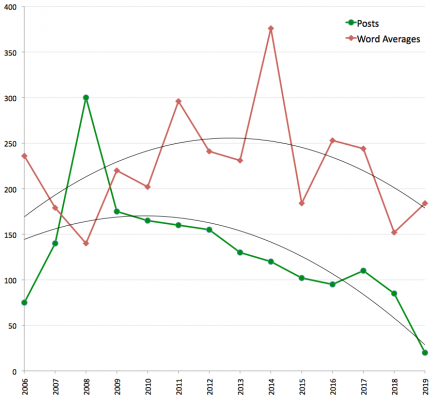
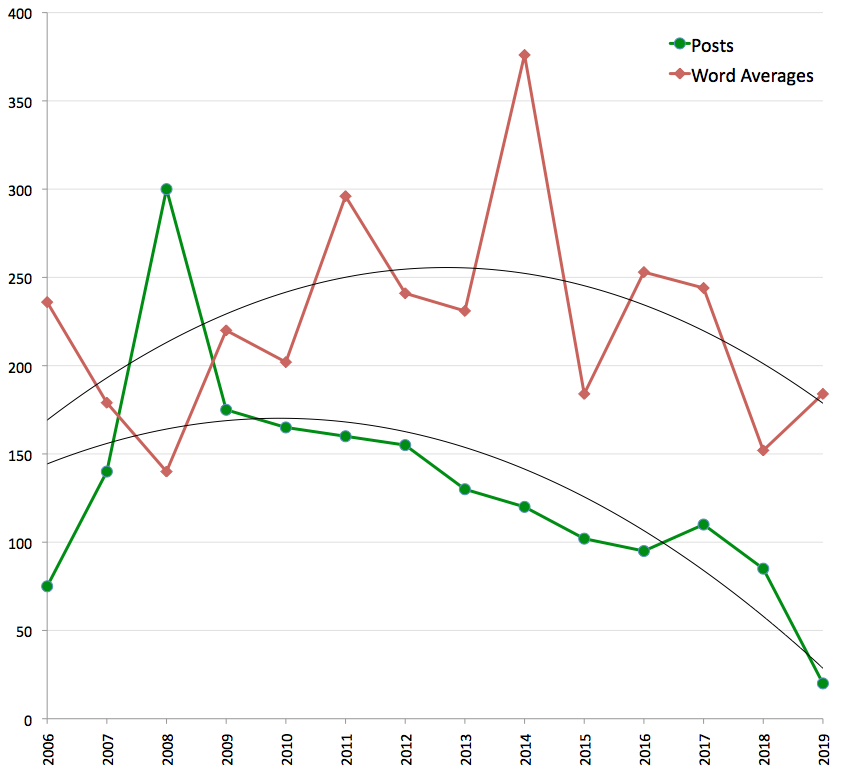
Above you can see (click on it for a larger version) a plot of the post and word count averages since blog creation. Ignoring 2006 and 2019 (both partial years of data) you can see that the average number of posts has been increasing steadily for a decade but the word count while drifting down does so at a slower pace.
All told there have been 1820 blog posts since the blog was created. That’s an average of 130/year or just under one every 3 days. I reached my posting peak in 2008 with 300 posts (!), but in recent years the average is under 100/year. This is in-part intentional, where I have attempted to focus on fewer more interesting posts rather than a simple chronologue of my model-making and game-playing exploits!
I’ve typed 178,229 words in those 1820 posts, with an average of about 99 words/post. To put this in perspective, here are the lengths of some well known books:
Animal Farm – 29,966 words
The Hitchhikers Guide To The Galaxy – 46,333 words
The Great Gatsby – 47,094 words
The Hobbit – 95,356 words
To Kill A Mockingbird – 100,388 words
Robotclaw – 178,229 words
The Fellowship Of The Ring – 187,790 words
Mody Dick – 209,197
War and Peace – 561,304 words
King James Bible – 783,137 words
So we can say I’m in Tolkein territory! A printed novel contains about 275 words per page, so if printed without comments and images, the blog would require about 650 pages!
If you’re curious about the longest posts, here are the top 3:
How Times Change (1571 words)
Shining Forth (The History) (1380 words)
The Vault of Helgorim (957 words)
Now let’s move on to the actual words…
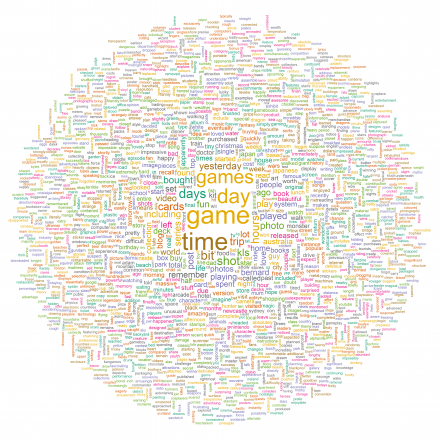
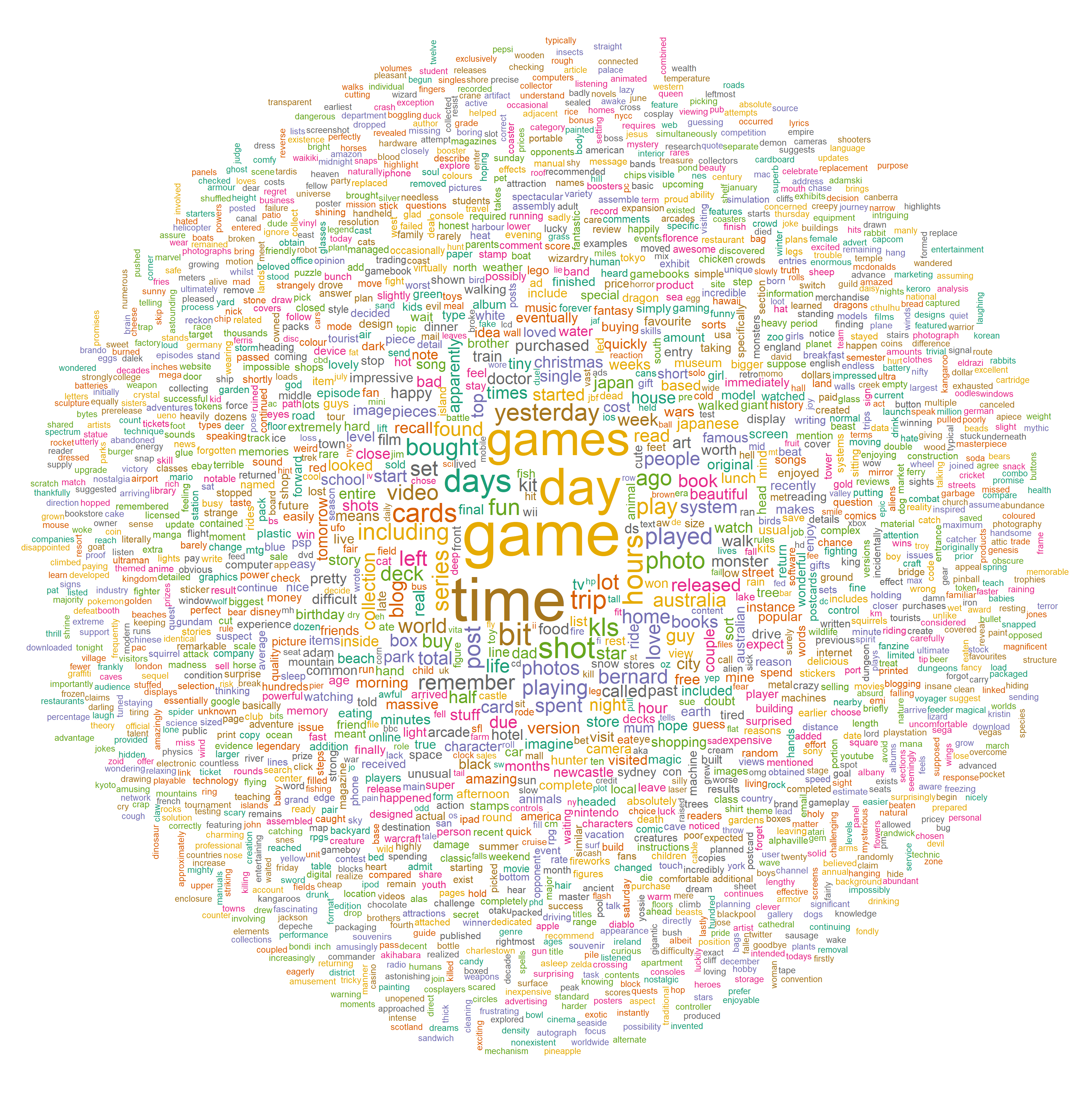
The above is a ‘wordcloud’ of many of the most commonly used words on this blog (click on it to see detail). In total, the written vocabulary here includes 20,705 unique words and of those, the ten most commonly used (in order) are: game, time, day, games, days, bit, shot, hours, cards and trip. And just because it’s cute, the eleventh most commonly used word is ‘kls‘ 🙂
Game, time, and day are each used over 1000 times (statistically game is represented in about 70% of posts!) and games is only slightly less than 1000. None of this is surprising: you all know about my game obsession and the other two (time and day) often occur in trip-related posts which have become a hallmark of this blog.
Yossie was mentioned 48 times across 35 posts, and thus placed just outside the top 50 words.
As for bigrams (two word combinations) the three most commonly used have been ‘star wars‘, ‘monster hunter‘ and ‘video games‘. I’m starting to think this is some sort of otaku blog!!
Of the 20,705 unique words, the most common word size was 7 letters, and the longest was 24. Bernard didn’t provide examples of each (what’s the 24-letter one?) but I think ‘monster’ must have contributed to the 7-letter median.
As for that vocabulary count… well it’s high. Here are a few others to compare (all these include proper nouns):
Alice’s Adventures In Wonderland – 2766 unique words
Pride and Prejudice – 6424 unique words
Oliver Twist – 10,419 unique words
King James Bible – 10,867 unique words
Robotclaw – 20,705 unique words
The Collected Works of Shakespeare – 31,534 words
So from the above, I think it’s appropriate to rate me halfway between The Bible and Shakespeare. (Incidentally almost half of Shakespeare’s 31k words were only used once, and depending on who you believe he actually invented anywhere up to about 1500 words, several hundred of which have never been reused by anyone and the meaning of some of which is still in question!)
A high vocabulary isn’t necessarily a good thing if you want an audience. The fewer unique words the easier something is to read, so I imagine the average reader may be a bit glossy-eyed by some of my content (for more reasons that this)!
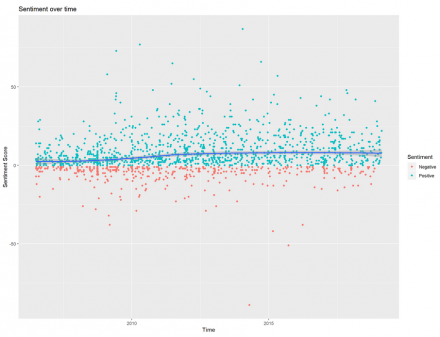
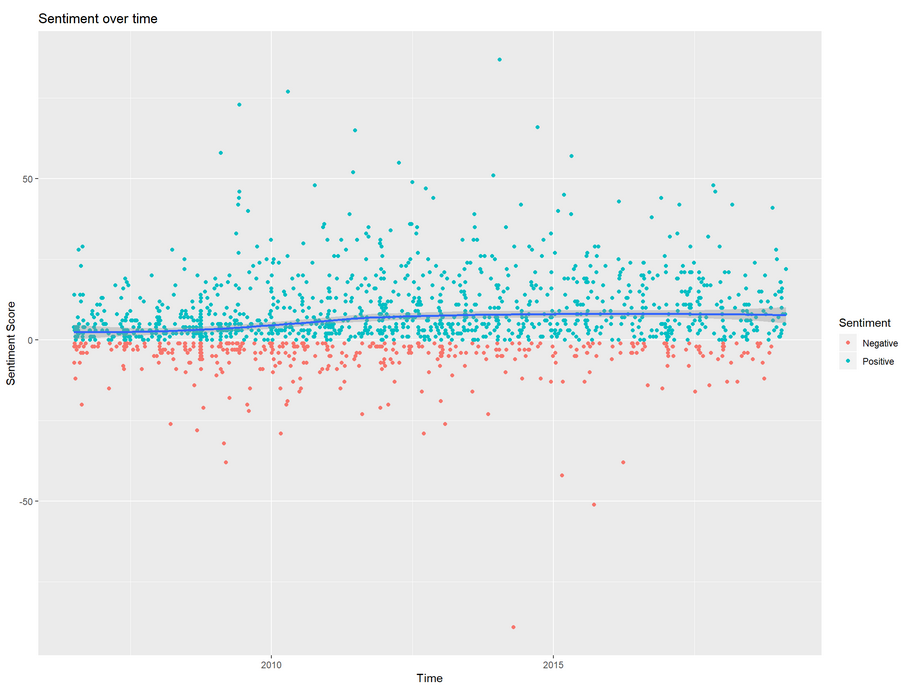
The above chart is taken directly from the data Bernard sent me, and shows the average sentiment of this blog. Happily it’s positive! In fact his conclusion was that the writings on this blog are in fact 78% positive and are becoming more positive over time!
The most common emotions in my writings are apparently ‘joy’, ‘trust’ and ‘anticipation’ with the least common ‘disgust’, ‘anger’ and ‘sadness’. Come to Robotclaw to cheer yourself up!
If you’re curious, here are the top three most positive blog posts:
Dream Gear Showdown (worth reading again for the awards ceremony alone!)
The Heart Of The Cards (features a ‘young Florry’ appearance!)
The Day Jesus, The Devil, King Arthur and The Magical Emperor of Light, Nero Griffth, Made My Dream Come True! (I’ll never surpass that post title…)
And here are the top three least positive:
The Vault of Helgorim (It’s a pretty grim adventure!)
Corporal Punishment (controversial!)
Review: Galactica 1980 (I literally laughed myself to tears re-reading this just now)
It’s mind-blogging to think of all this I’ve written and uploaded over the years. Every now and then I go back and re-read posts and forget writing them, and are often entertained myself. I still love the blog and still love writing it so you can look forward to much more in the future, and I promise I’ll try to stay positive and keep delivering you the high-vocabulary, star wars and monster hunter themed content you know and love 😉