Category: Collecting

Train Stamps

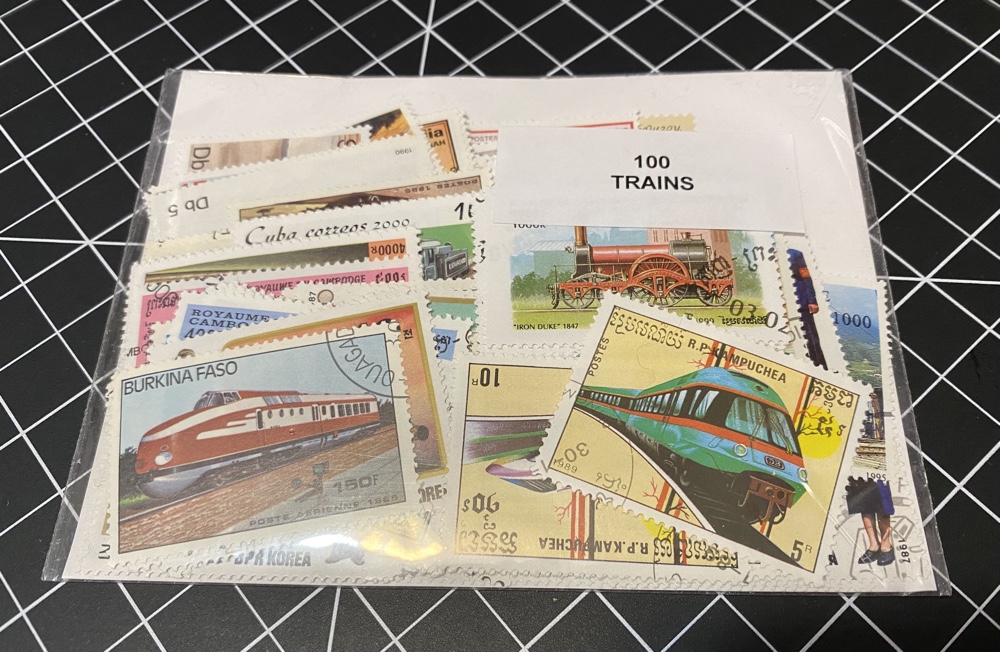
It’s time for some more stamps! This time, trains:

I didn’t actually choose these when I did my order. I chose another topic that it turns out was out of stock, so (at my request) these were substituted. They were very inexpensive: I think about $3 for 100?

The pack contained slightly over 100 stamps, and I forgot to take a photo of them all together! So here I’ll showcase the stamps from some (but not all) of the countries. They seem to be mostly issued between 1980 and 2000.

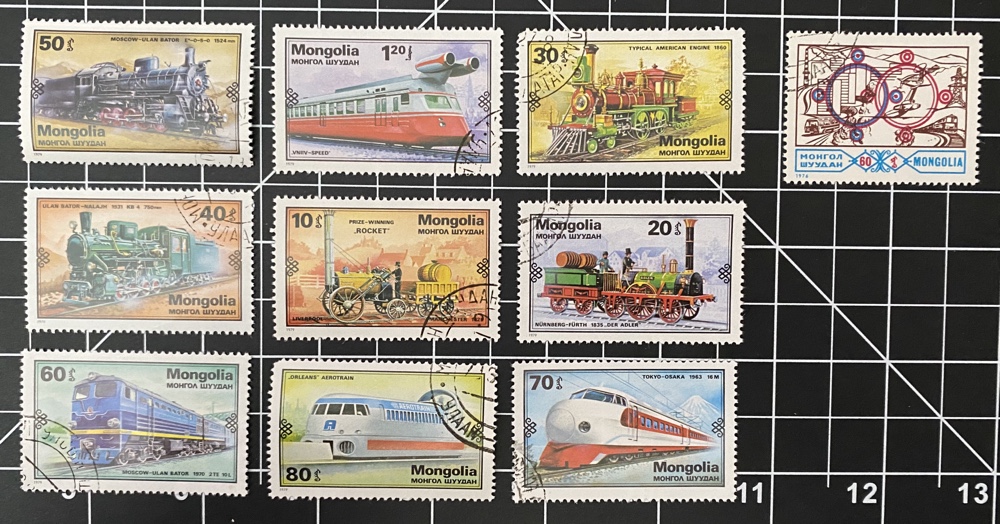
As with mushrooms and dinosaurs, almost all of these are CTO stamps, which means machine canceled and unused. They come from the same countries as well; and my guess is very few of any of these were ever sold for actual postage use.

Take Mongolia for instance, a country not known for its rail heritage. The stamps are pretty enough, but the likelihood is they were printed in Europe or the USA under license from some Mongolian government office who likely had nothing at all to do with their design. I wonder could I take these to Mongolia, put them on a postcard, and expect it to arrive?

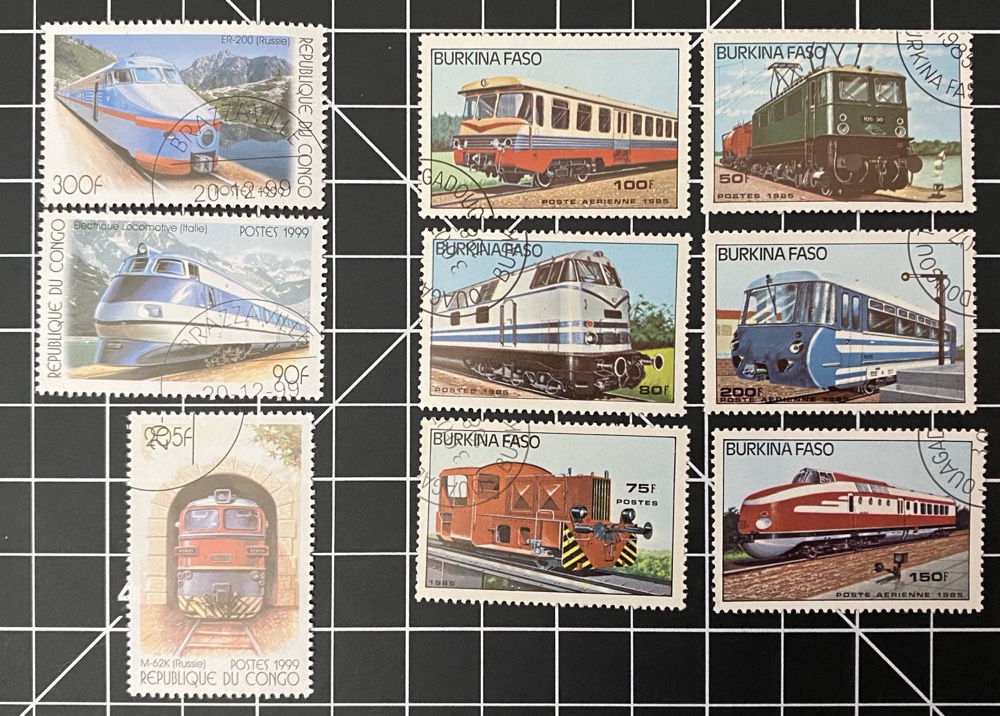
The same can be said for Burkina Faso:

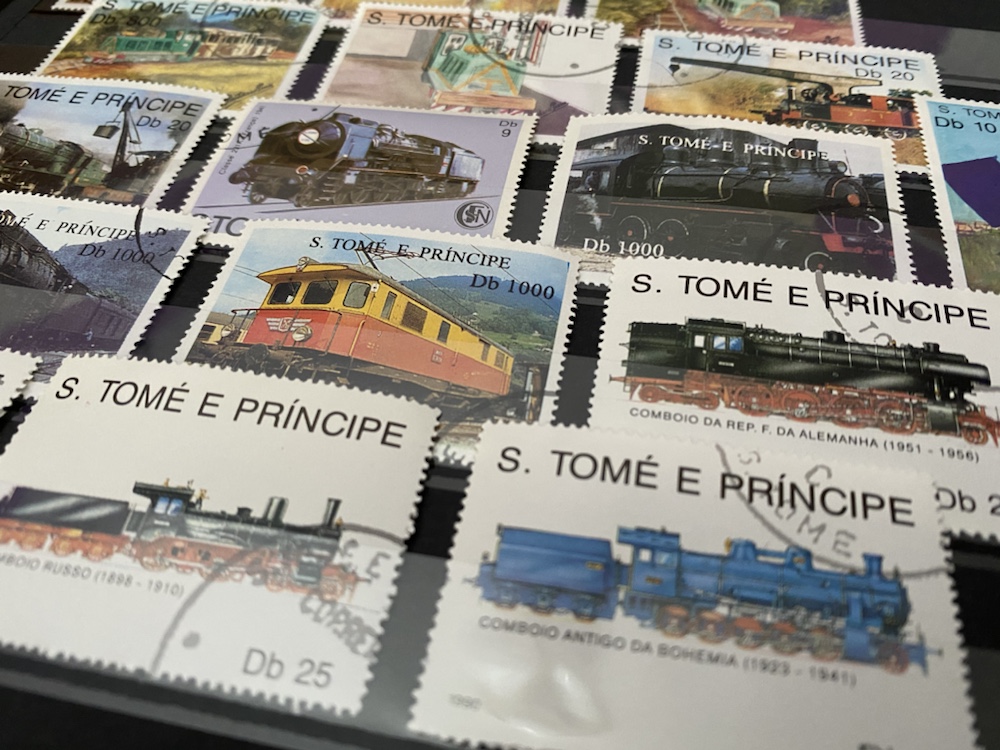
And São Tomé:

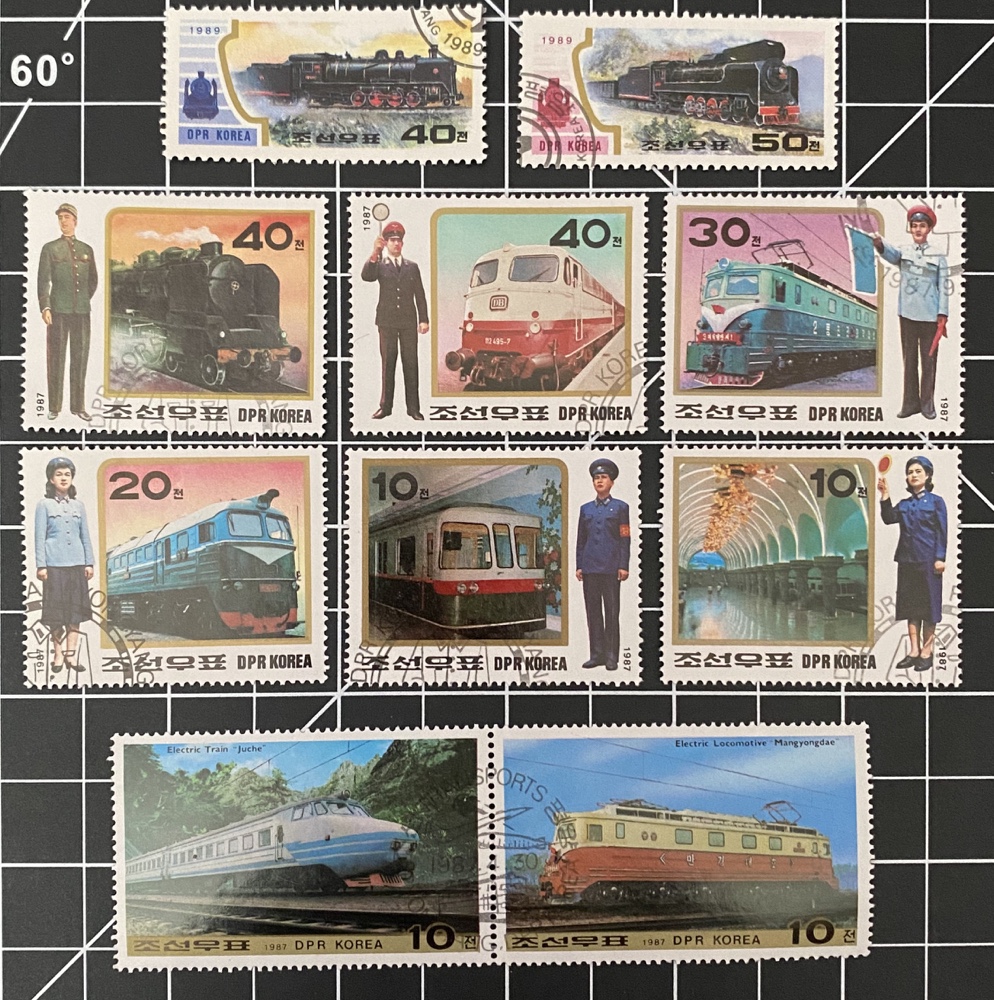
And North Korea:

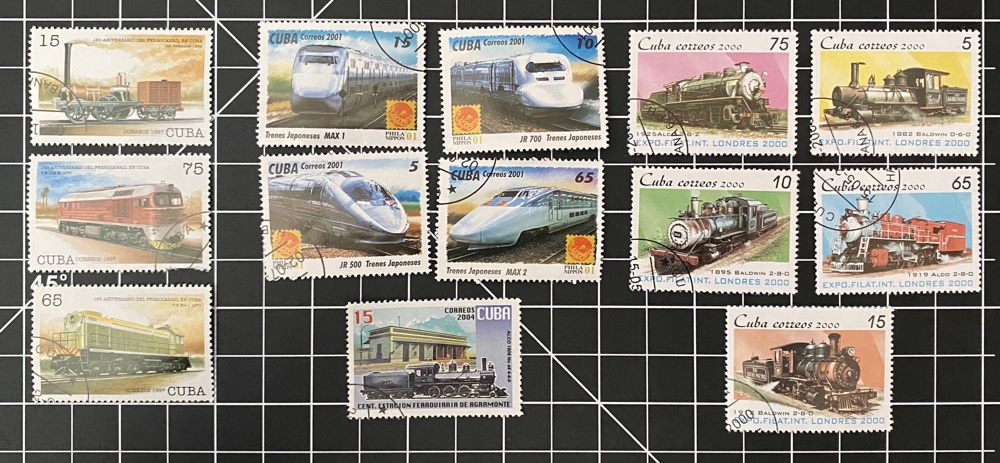
Cuba is of note since they issued a series of CTO stamps celebrating Japanese bullet trains!?! One can only imagine this was done to market to Japanese collectors:

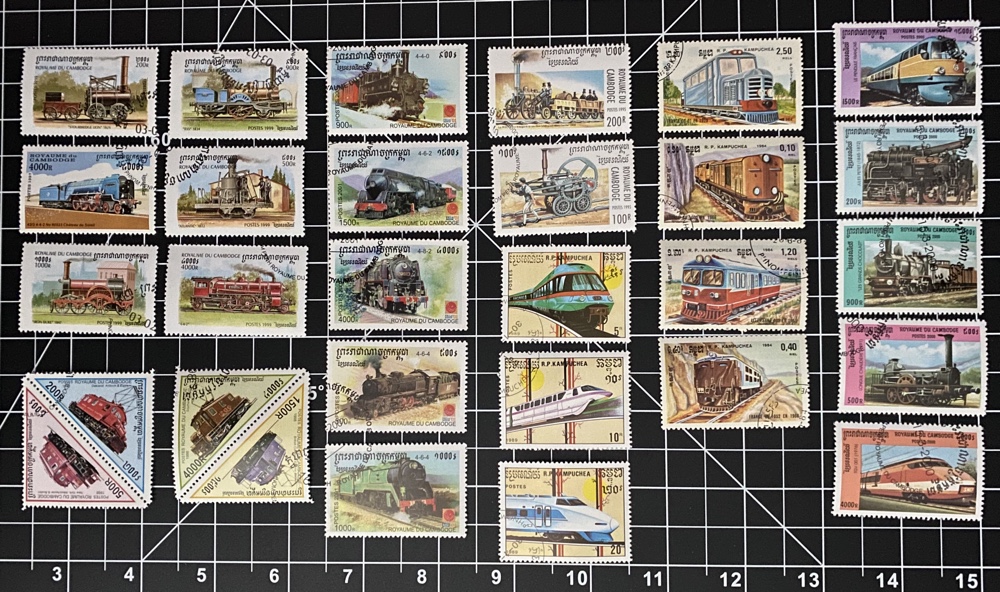
And of course let’s not forget Kampuchea/Cambodia, which based on the contents of this pack has issued a ludicrous amount of train stamps. Given the then-recent history of that country, I’m slightly surprised ‘they’ issued so many CTO stamps:

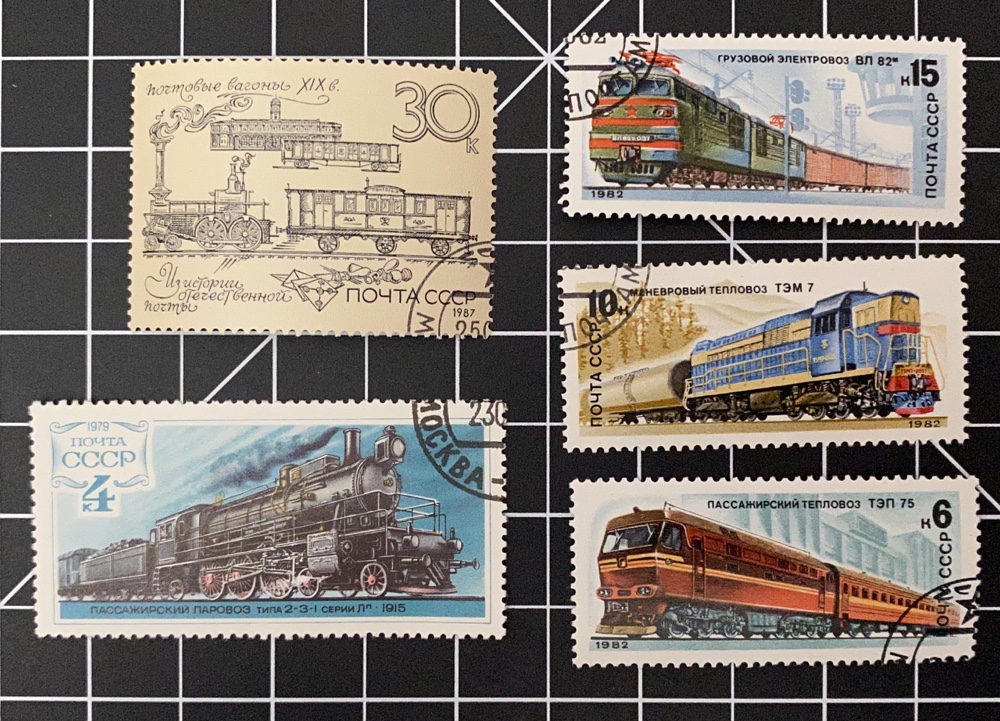
The above stamps are from the Soviet Union, and the one on the lower left was used (it’s a real postmark and the stamp has no gum). I assume the USSR issued CTOs (almost every country has) but as far as I can tell the above are all ‘real’ stamps issued for actual postal use. My favorite stamp in the packet is the top left one above, which also happened to be the most monochromatic!

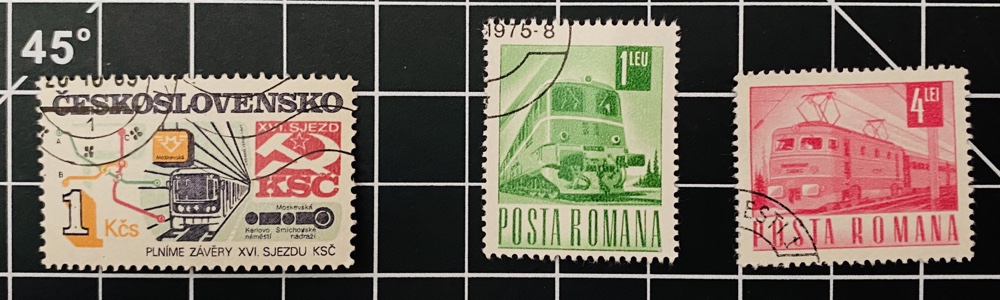
The Czech stamp on the left above has also been used, and at least one (and probably both) of the Romanian ones on the right was as well. Both of these are examples from larger issues, which supports my theory that these are ex-post rather than just bought from a wholesaler.

So in a packet of 100+ stamps it seems only three were actually used. This is not surprising given the nature of the product, but given that trains as a topic ate so popular I would have liked to see a few more examples of ‘real’ train stamps from around the world! My pack of Australian stamps for instance contained several, and the USA has issued well over 100 train stamps during the last 75 years.

Who knows… maybe the next pack of stamps I open might have some trains in it! What will that pack be? Find out next month 🙂

Australian Stamps

It’s time for another selection of stamps from the order I made a couple of months back. This time, let’s look through a pack of 200 Australian Stamps.

That’s all of them, with the exception of a tiny amount of repeats. They span about 60 years from 1949 to about 2008. Here’s the oldest one, which was also the only pre-decimal stamp in the pack:

You can see in the first pic that Australia has a standard stamp size (that continues today) in which the vast majority of stamps are printed. The second photo shows the smaller size, with some smaller (older) stamps at the bottom. Australia does of course print stamps in other shapes and sizes than these, but they are usually higher denomination or for specific commemorative purposes.

Looking at this specific selection it’s clear there are a few recurring themes. One is sports, and the above photo shows many of those in the pack. I was surprised by the absence of cricket stamps, but a quick glance online shows they have existed and were simply not in my selection. There were several Olympic themed stamps in my pack as well.

Vehicles were another theme, and I recall collecting some of the plane ones in my youth. The car series is quite handsome!

There were several train stamps as well, from at least four different series over a couple of decades. Obviously a popular topic of Australia Post.

Christmas stamps were extremely common, and this picture isn’t even all of them. Over 10% of the 200 were Christmas stamps, and they’re such a tradition in Australia that they even print Christmas stamp stamps, like this one:

There were actually two different stamps commemorating Christmas stamps!

This got me thinking “How did this company get these Australian stamps?” I bought the packs from a stamp dealer in Canada and I assume his various country selections originated from the countries themselves? Are there companies in Australia that collect used stamps (from envelopes possibly?) to sell to dealers overseas? If so, this could explain the frequency of Christmas stamps since I would expect most Australians are likely to send Christmas cards than use the postage in the rest of the year?

The most common topic – and this has always seemed to be the case – is of course Australian wildlife. Check your postcards I’ve sent you from Oz over the years and you’ll likely see animal stamps on them, including perhaps some of those shown above!

A few other stamps caught my eye, such as these two from series about children’s novels:

Or this example of a stamp about stamps (sort of):

There were many other interesting ones but this post is already too long. As with the previous packs I had a lot of fun sorting these and looking up details on many of them.

I still have more packs to go through as well. What will the next one be? Check back in a month or so and find out 🙂

My Collection: PlayStation 2

The PlayStation 2 (PS2) was Sony’s second game console, and was a dramatic upgrade to the original PlayStation. Released in the USA in late October 2000, I got my first PS2 a few weeks later from Working Designs, since I was then writing content for their website.

It was an extremely successful console – to date the most successful (although it will almost certainly be surpassed by the Switch) – selling over 150 million units in over 12 years of life. It has a massive game library and many extremely successful franchises that continue to this day began on the PS2. Historically, this will always be remembered as one of the most important game consoles in history.

Even though it’s still relatively young, some elements of the console feel archaic today, such as the use of dedicated memory cards for storage, the wired controllers and the lack of any built-in internet support. It did however play DVDs, and for many homes was their first DVD player, which was one reason for its great success.

Over its lifetime I bought well over 150 PS2 games, but I traded many in and my remaining collection (115 games) is shown above. Unsurprisingly this is mostly RPGs (since I was reviewing all of them in those days), and virtually every game you can see was beaten to completion.

The graphics hold up reasonably well these days: certainly much better than the original PlayStation. This was also the era in which cutscenes really took off since loading time and video quality had improved significantly over the previous generation. Playing the games now isn’t too great though since the (first generation) Dual Shock analogue controllers feel slow and stiff, and the memory stick system is clumsy.

The PS2 was also regionless, and this was the era in which I started semi-regular trips to Japan. That said I only bought two PS2 games while I was there, both of which I beat completely despite having not being able to read the text!

As I said there’s a plethora of incredible games on the system, including the mighty Final Fantasy XII, the Ratchet & Clank games, the first Monster Hunter and many others. But for me the Naval Ops series will always be remembered fondly. These are action games in which you develop and fight warships in combat. It starts off realistic enough, but by the end you have star destroyer sized submarines with wave guns and laser cannons. They’re all fantastic!

For an extremely popular system with so many great games there’s relatively few ‘holy grails’ on the system as far as collecting is worth, and the vast majority of games these days can be bought for less than when they first came out. The two shown above are probably the rarest in my collection, each worth over $100, which is modest compared to games on other systems.

As the PlayStation has evolved through the generations (now up to the PlayStation 5) the differences between successive iterations has become less and less. I feel the PS1-to-PS2 jump was the biggest, and for that reason remember this console more fondly than any other PlayStation. That said I’m not overly nostalgic about it (or it’s games) like I am handheld or Nintendo systems.

It was fun getting it out and firing up the games for a spin, but I think if the day arrives I decide to sell more of my collection it’s likely my PS2 games will be on the list.