Category: Gamebooks

Some Gamebook Reviews

Back in the summer when our bathroom was being renovated, I ‘lived’ downstairs with Zoffy. I took the chance to grab some unread gamebooks from my shelf and play them. Here are my thoughts.

Star Bastards, successfully kickstarted in 2016, is supposed to be a newly rediscovered ‘long lost’ gamebook from the 1980s. I think it largely misses the mark both as a work of fiction and a game.

You choose one of two roles before you begin (law enforcement or a fugitive) and the story involves the cop chasing the criminal through space. I played the fugitive and in my first playthrough won (I think?) in fewer than 25 entries. The ending was vague enough that I wasn’t sure if it was a good or bad one, but I had no interest in trying again.

The game has lots of overly complex systems, almost none of which (including combat!) I used in my playthrough. The writing, while verbose, often lacks detail and the comedy is weak and breaks the fourth wall in a way that doesn’t really work.

While the book has more art than most modern gamebooks, it’s fairly amateur and in some cases visibly pixelated as of the source files were low resolution.

This book is a miss. I actually own the second in the series (a fantasy tale) which I’ve read isn’t ‘as good’ as this one so it’ll probably sit on my shelf a while before I read it.

Secret Of White Monks Abbey, released back in 1985, is a strange book. It’s unlike the others included in this post in that is is (almost) systemless and every entry is a single full-colour page. But while brief, it’s a little more complex than your typical choose-your-own-adventure.

There are only 46 entries, and a single playthrough includes only about 10 to 15 of them. The entries are very short and as a result the story is very disjointed with frequent and unbelievable location changes.

It’s not a difficult book, and trial-and-error alone got me all the endings in well under an hour. None of the endings made any logical sense, and in the end it’s not ever even fully explained what’s going on in the titular mansion.

While obviously written for children, I wonder if a young reader would have enjoyed this even way back in 1985?

The House On Sentinel Hill is a Lovecraftian book released in 2022 which of the ones in this post is closest in format to a Fighting Fantasy book. It’s a well written and structured book which suffers from a very high difficulty.

Set in 1926, you play an investigator visiting an abandoned (or is it?) old house in New England and quickly getting mixed up in all sorts of cosmic horror. The story and writing are both strong from the start, and its cinematic in style and very faithful to the works of H. P. Lovecraft. It’s also got lovely, creepy art.

But it’s difficult. Not only does it have a punishing sanity mechanic (like the Call Of Cthulhu RPG), but the default player stats lead to failed rolls 58% of the time. There’s a lot of instant deaths, many of which have no preceding hint or warning, and most of which are distinctly grim.

When I played these books – since I was taking notes to review them – I decided to play them faithfully and not cheat. For this book this meant many deaths. I was so intrigued by the setting and the story that I kept trying and ended up playing it over half a dozen times before putting it down. I kept getting stuck at the same point: entering combinations into a weird alien machine. While several of my attempts had me visiting bizarre dimensions and being killed by various cosmic beings, flipping through the book showed me there was still a lot I never saw.

I wondered what I had done wrong and eventually sought a hint online. I managed to find a Reddit post by the author himself who gave a vague hint which didn’t help at all. Other reviews commented on the difficulty as well, and some specifically cited the same combination that stymied me! I never did find the solution.

It’s a good book, but too difficult.

Western gamebooks aren’t common, and Raining Hammers may be the only one I own in a collection that now numbers well over 500 books. This is a book written for adults, with mature themes and writing, and takes a realistic (as opposed to fantastic) approach to its story of a lone gunman on a mission of revenge.

From the start this one works against the reader. The author made the unusual choice of writing the book in third person, which doesn’t work in a gamebook. It doesn’t feel like a gamebook either, as if the author wrote a normal book and then tried to turn it into an interactive one.

The first entry is almost a novella at six dense pages of tiny font, and sometimes I went from entry to entry with no decisions to make. It’s mostly linear, but also has occasions where you can revisit areas which don’t work in the context of the story. The gambling system also feels like it should have been cut, but perhaps if it had been this would have felt even less like a gamebook.

I think this one tries hard, and almost works, but in the end felt more like reading a novel than playing a game. I didn’t win, but I also didn’t care to try again. I think its legacy is that at 26 years old now it remains one of the very few gamebooks in its genre.

Nightshift is the best of these five by a wide margin. I was dubious at first since this is a book with no combat or even dice, but the puzzle-based gameplay is clever and the story well-written and very creepy.

You play a hospital worker who finds themself trapped in a hellish dimension full of demons, witches and all sorts of other weird denizens. You wander the hospital seeking a way out, and must solve many puzzles to find the true path to victory. I’d liken the story to Silent Hill or Hellraiser and it can be genuinely creepy at times.

As mentioned the writing is excellent, and the author skillfully avoids the usual pitfalls of gamebooks set in the modern world. At first the cause of the madness is unknown, but the slow reveal of what’s actually going on is done skilfully. I was particularly impressed by how well this worked through multiple attempts, where initially innocuous events sometimes take on a very different meaning.

The puzzles range from typical inventory or codeword based ones (do you have the brown key?) to math puzzles, word games and some that are more complex and clever. While dice are not needed, you will have to keep careful notes if you hope to beat this one.

This is the first in a series of six books by the same author, although I don’t think the stories are related. I was impressed enough I bought all the others, and look forward to playing them. This one is recommended.

Japan Pickups: Gamebooks

It was a good Japan trip as far as my gamebook collection goes, with both old and new products found. This post lists everything I bought.

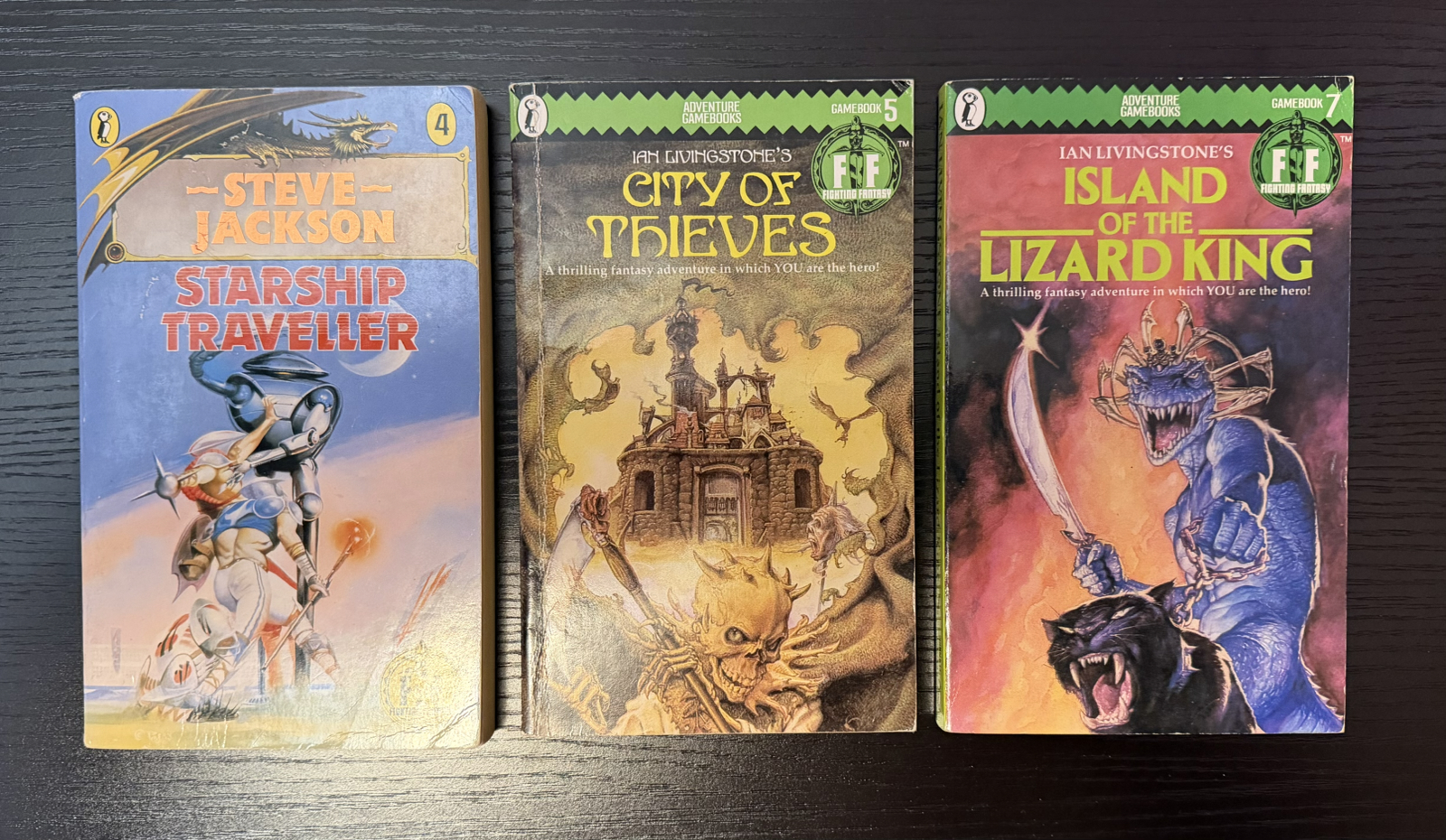
I’ve got a lot of Japanese Fighting Fantasy gamebooks (about 2/3rds of the original run) but somehow the third book – Forest Of Doom – had eluded me. I was surprised to find a copy for very cheap (¥1000) at Mandarake.

According to the publication history, this is the 17th edition from March 1986. For a nearly 40-year-old book it’s in astonishingly good condition, as if it just came off the press.

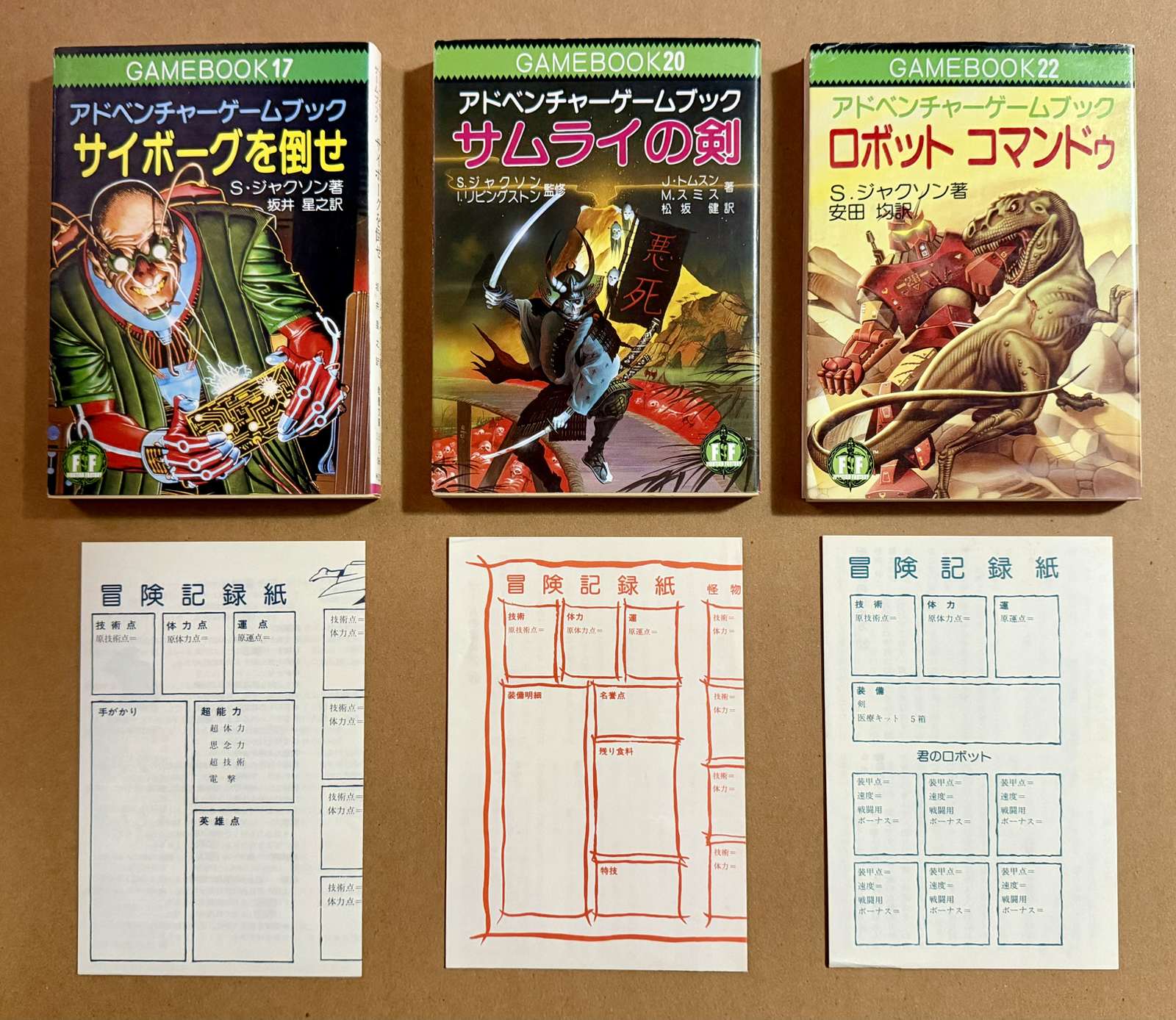
Japanese FF books included pull-out adventure sheets and this is perhaps the best example I have yet seen. I don’t think this book was ever opened, much less read, and it’s now got a permanent home in my collection.

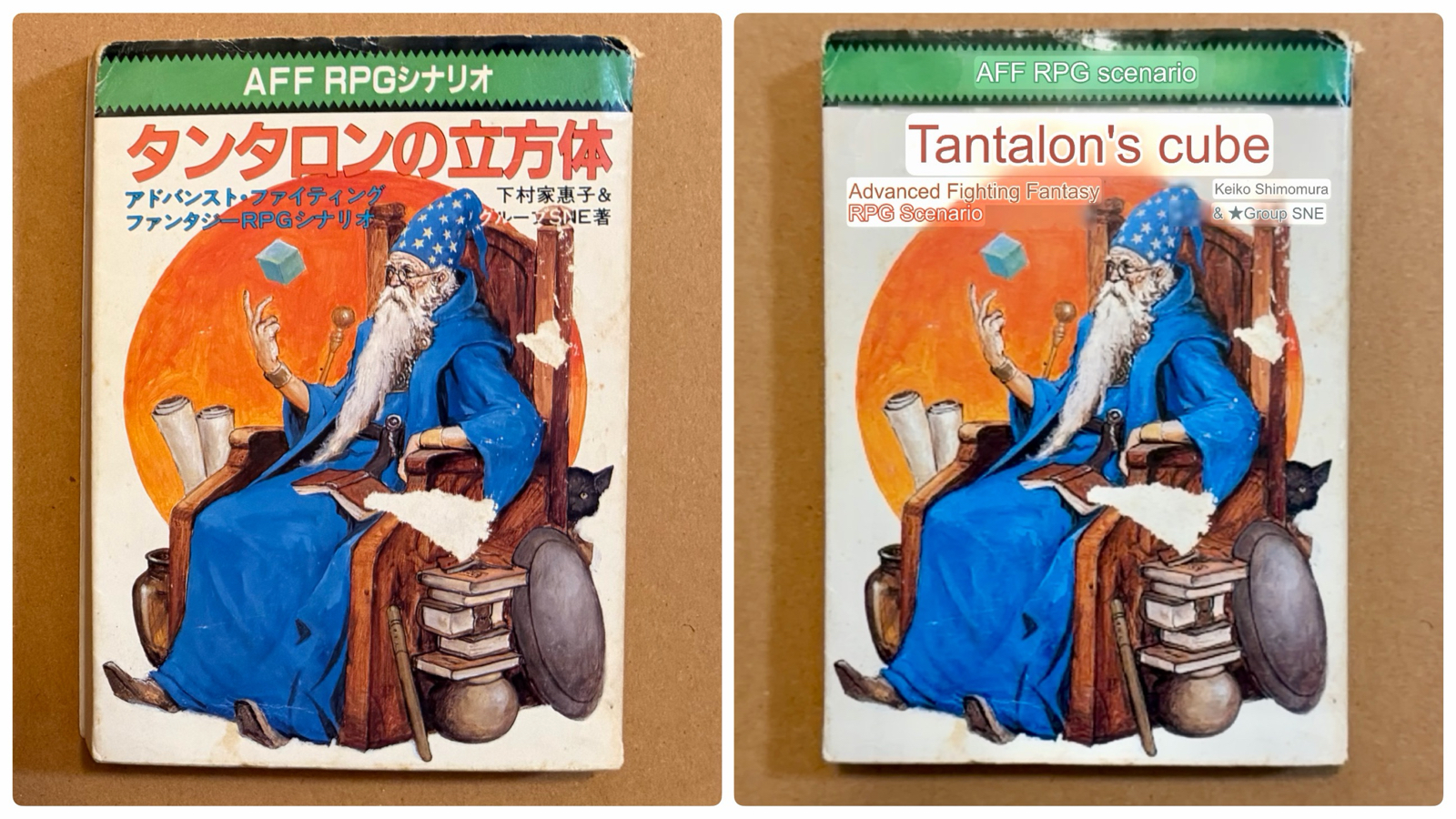
I also bought the book on the left, which shares the cover art of Dungoneer, the first rulebook for the Advanced Fighting Fantasy RPG. The Japanese book has a different title (Advanced Fighting Fantasy volume 1) and is slightly shorter, with some material removed. It seems Japan compressed the three AFF volumes into two, but there’s detail here I have yet to discover. Again this book was extremely inexpensive (¥500!) which shocked me since I wouldn’t have hesitated to pay twenty or more times as much.

I finally found the 4th Group SNE FF reprint box set, which allegedly published early in 2024 but I had never seen in my previous three trips. This collects the Sorcery! set and Secrets Of Salamonis, which receives its first Japanese printing here.

These trade-sized reprints continue to be definitive, with beautiful presentation, paper quality and reproduction. The bonus book in this set is unsurprisingly the Sorcery Spell Book.

Even though I already owned five (!) complete sets of the Sorcery series (including the Japanese versions from 1985 and 2004) I’m happy to add this new set to my collection.

To my surprise there was also a fifth reprint box set available! I later learned this one was only just released, which explains why I saw it in many bookstores. It contains a collection of five books, including two new to Japan: Howl Of The Werewolf and Crystal Of Storms.

Two of these are particular interesting. Starship Traveler hasn’t been reprinted in over two decades, and it’s long been rumoured the reason was due both the cover and internal art. This reprint seems to confirm both, with a new cover and new internal art:

The copyright page reveals the art was taken from the TinMan digital version of the book, and while the style is different from the line art common to the series, the reproduction is excellent and overall I think it suits the book well.

Scorpion Swamp has never been reprinted (in any language), and there have been a few theories as to why including art or the author not allowing it. And yet here it is, with a new cover and internal art:

The above picture contains the original art on the left and the art from this reprint on the right. As you can see the artist (who also did the art for Secret Of Salamonis) has drawn new versions of all the old pieces, and his style matches the series perfectly. The art is copyrighted 2025 to Ian Livingstone and I suspect this was done to enable future reprints, possibly including in the new American Steve Jackson Games versions? Let’s hope this means the other books that have never been reprinted will see new versions as well.

Moving away from Fighting Fantasy, to my surprise I found this:

This is a gamebook based on the Xevious arcade game! I would have thought this was somewhat well-known amongst hardcore gamebook collectors (how many exist?) and therefore I was surprised it only cost me ¥1000.

Flipping through it is most definitely a robust gamebook with inventory and systems, almost certainly modeled after a FF book. Even though it’s a different publisher, the back of the book even includes ads for other gamebooks including FF and the Back To The Future one I bought a few years ago.

What a strange beast this book is! The art inside shows almost no space battles, instead seeming like a standard adventure with fights against monsters and villains. Xevious also had some novels written about it, but I don’t know if there’s any connection between those and this gamebook.

Speaking of space-themed Gamebooks, the above was almost inadvertently found in a bargain bin at BookOff and cost a mere ¥100! I thought it was Star Wars related at first, and was shocked to realize it was a gamebook.

This is an interesting CYOA style book where each section has at least a half-page illustration. The text seems simple enough that I think this will be playable with a translator. While it’s not licensed item, the Star Wars ‘homages’ are obvious, from the cover to the hero’s robot which looks exactly like R2. Based on an add on the final page, this seems to be the first in a series of two books; I’ll be looking out for the other on future trips!

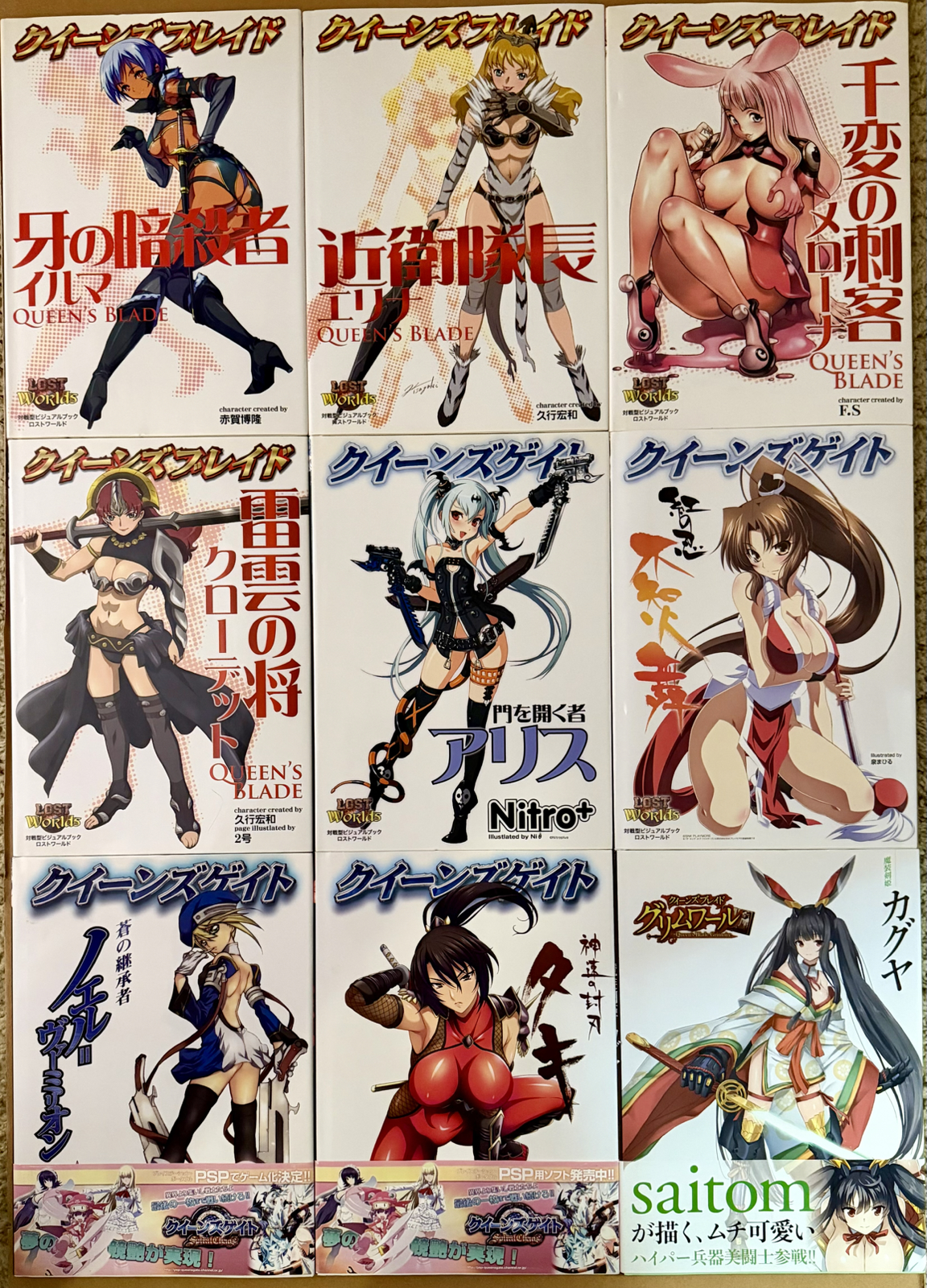
And lastly we have a Queen’s Blade book, Alicia the Dark User of Wonderland. I’ve got a lot of these two-player books which sprung from a US series called Lost World but took on a life of its own when rebranded with anime girls in Japan. I see these occasionally in Japan but often skip them since they’re a bit heavy and I don’t want to fill my suitcases with them 🙂

Japan Pickups: Games

I’m using ‘games’ here to describe video games and ‘TRPGs’ (as tabletop games are called in Japan). This is the category in which I’m always hunting for items on my trips and this time I was very happy with my finds…

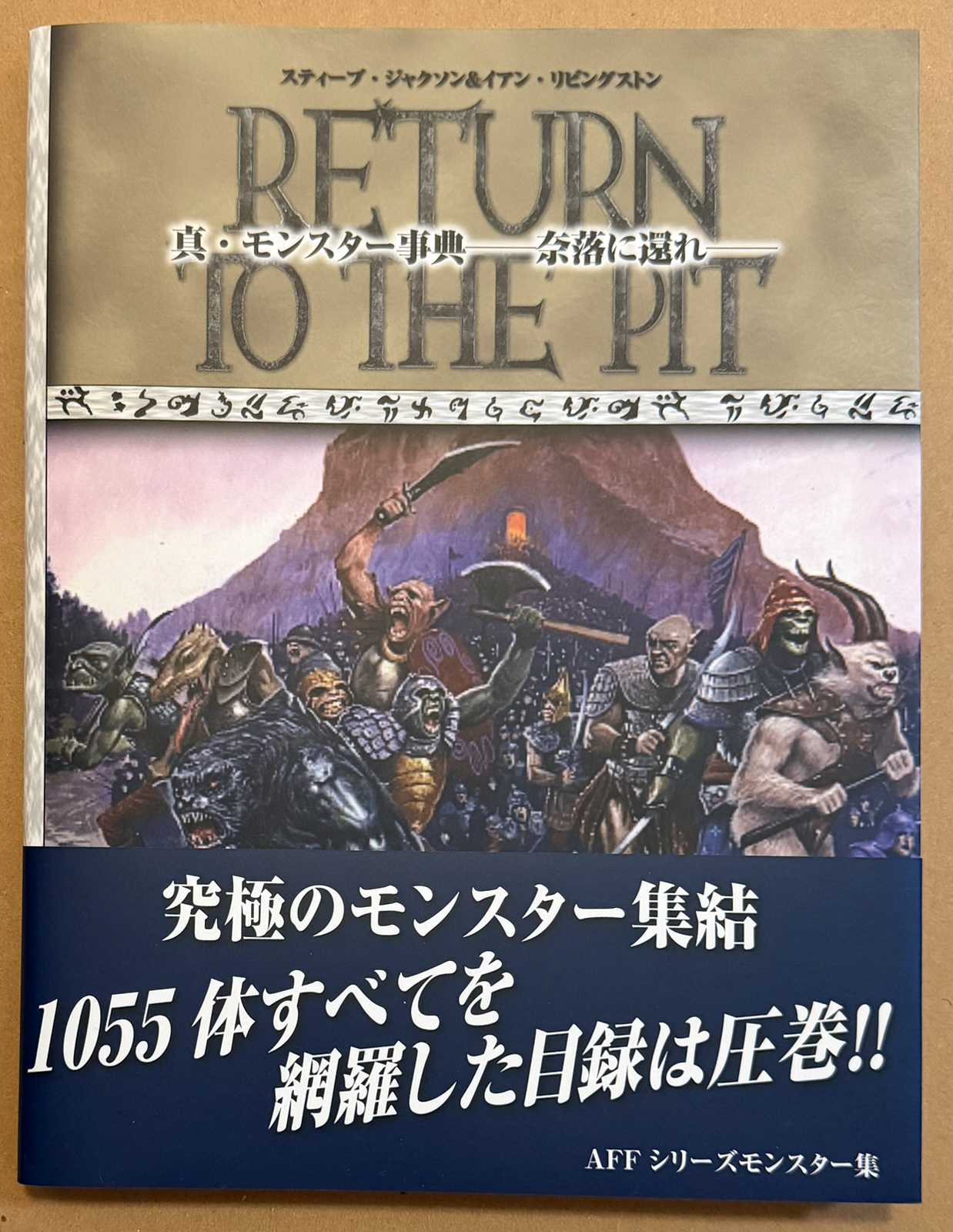
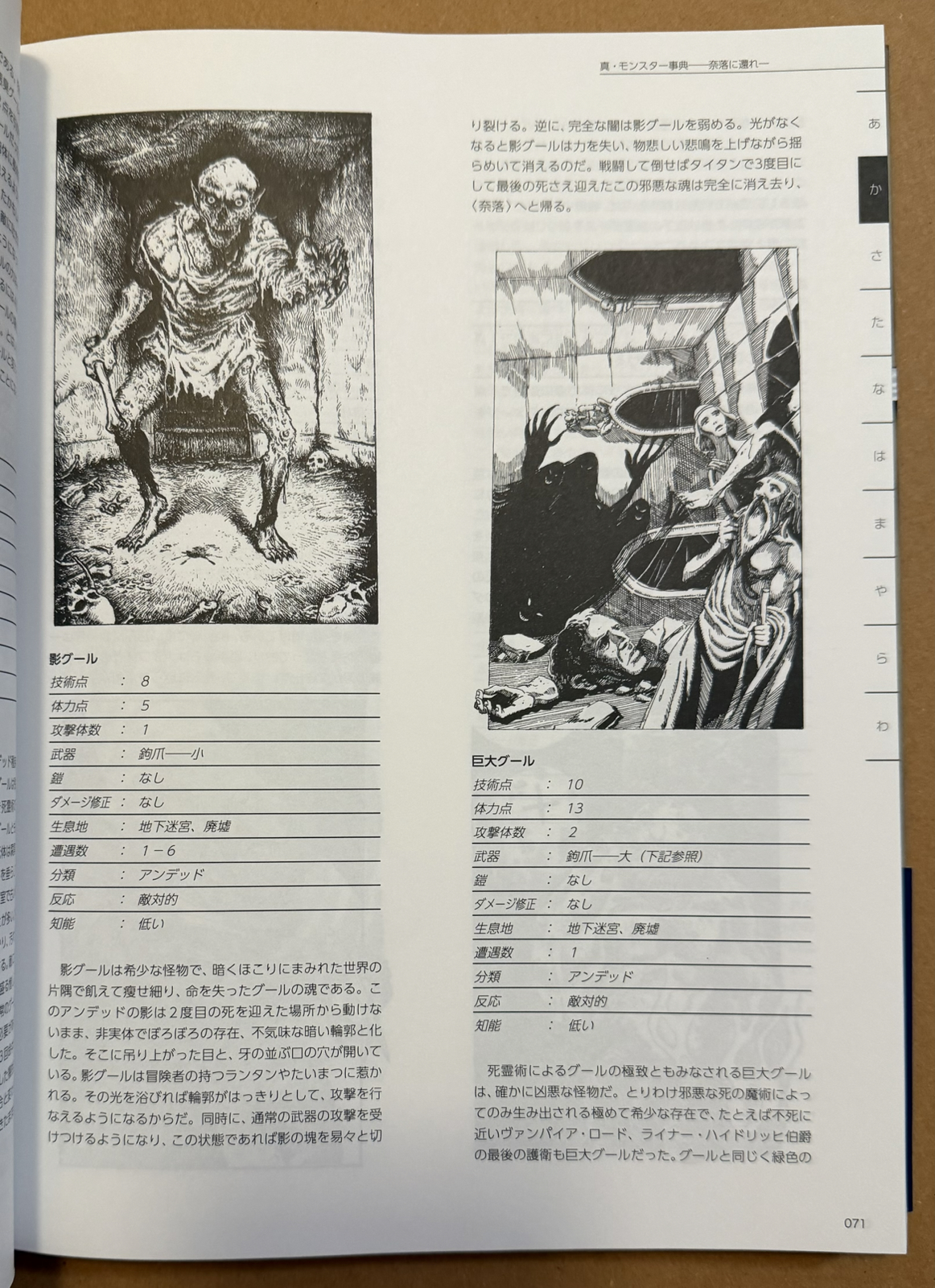
It’s been a while since I’ve found a new Japanese Fighting Fantasy book for my collection, so I was pleased to see this JP version of ‘Out Of The Pit‘, the FF Monster Manual. Unlike the western version, it’s published at the same size as a normal FF book and is therefore a chunky little volume. The cover is a little tattered, but it’s in otherwise excellent condition and included its obi and even an advertisement for the Japanese Warlock magazine.

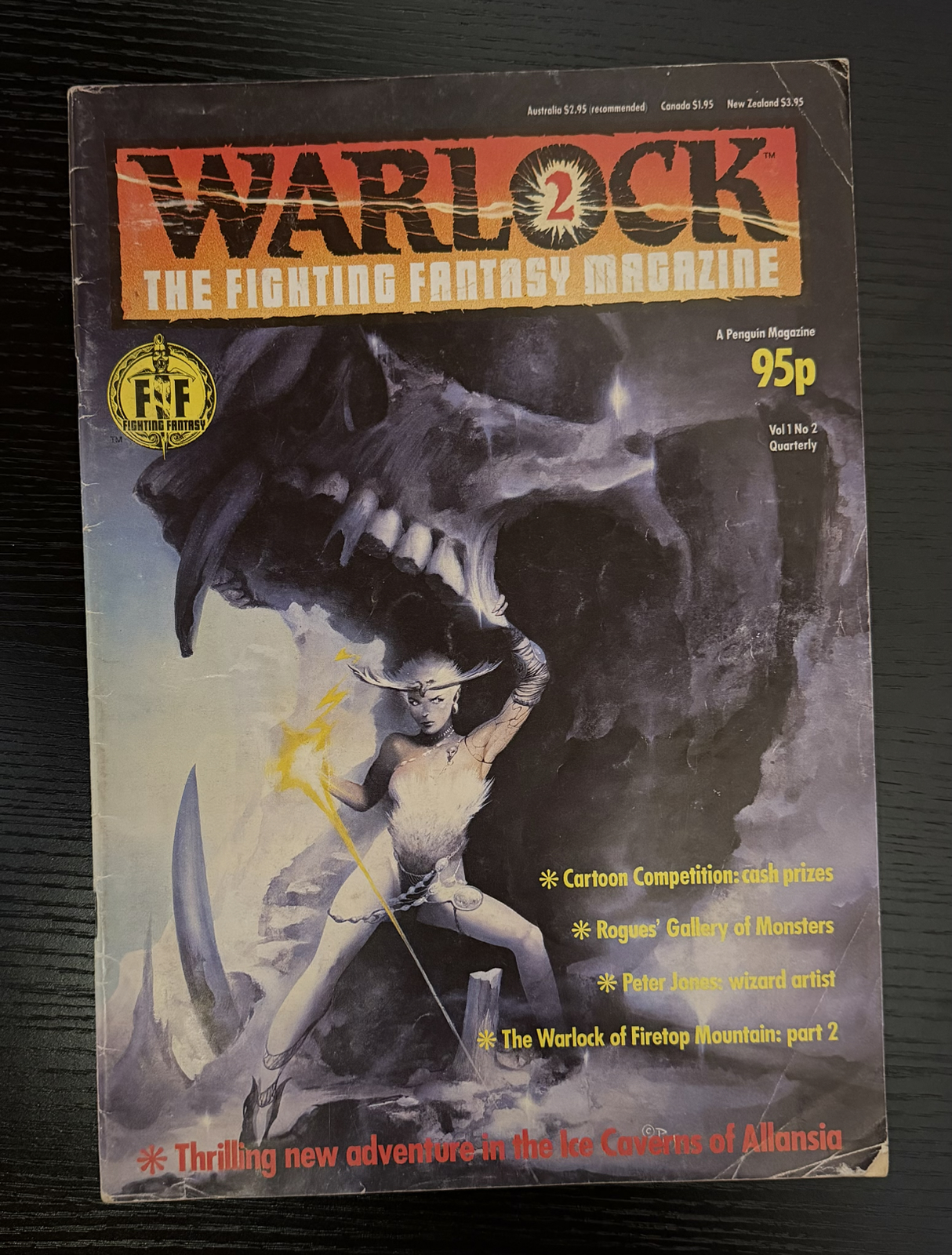
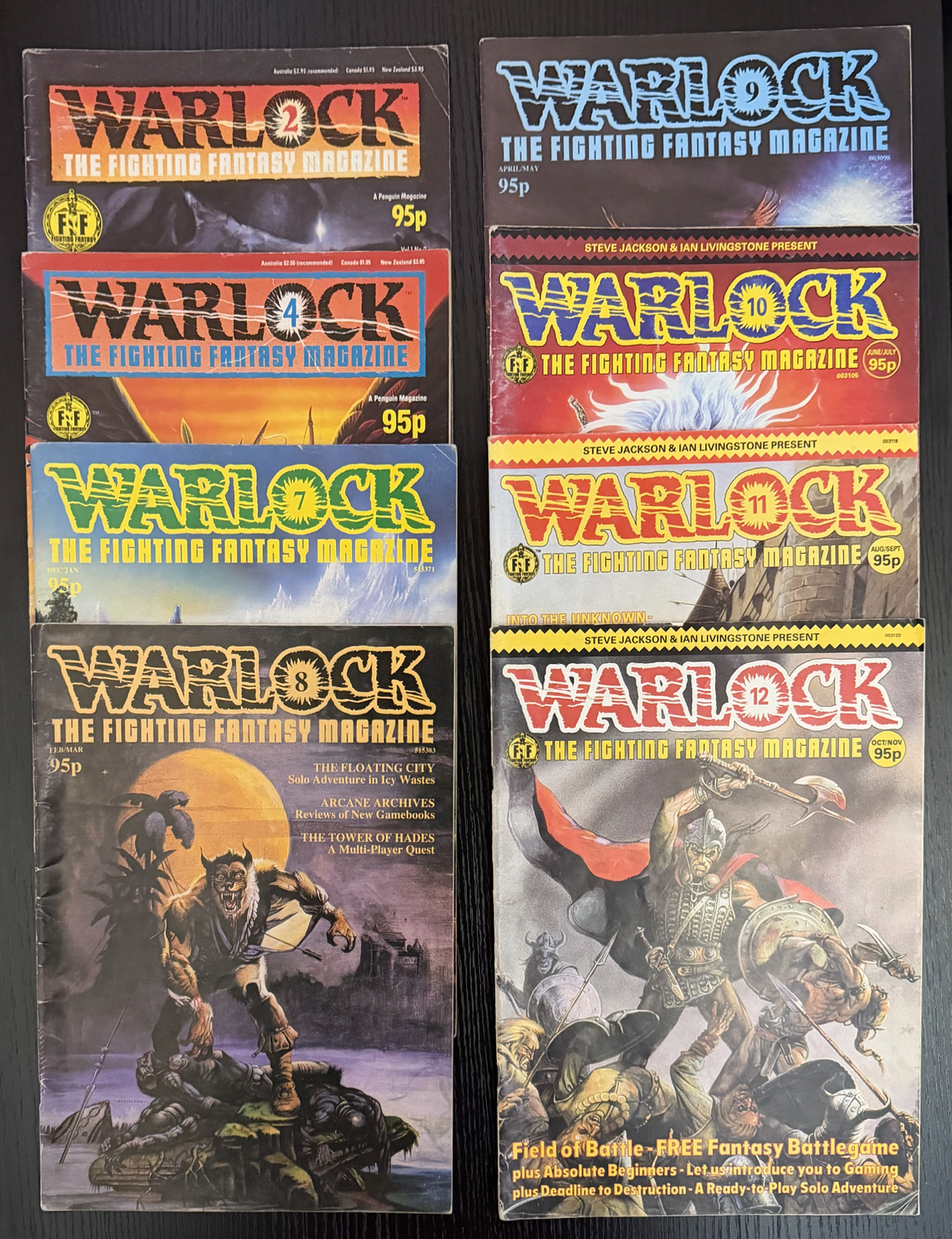
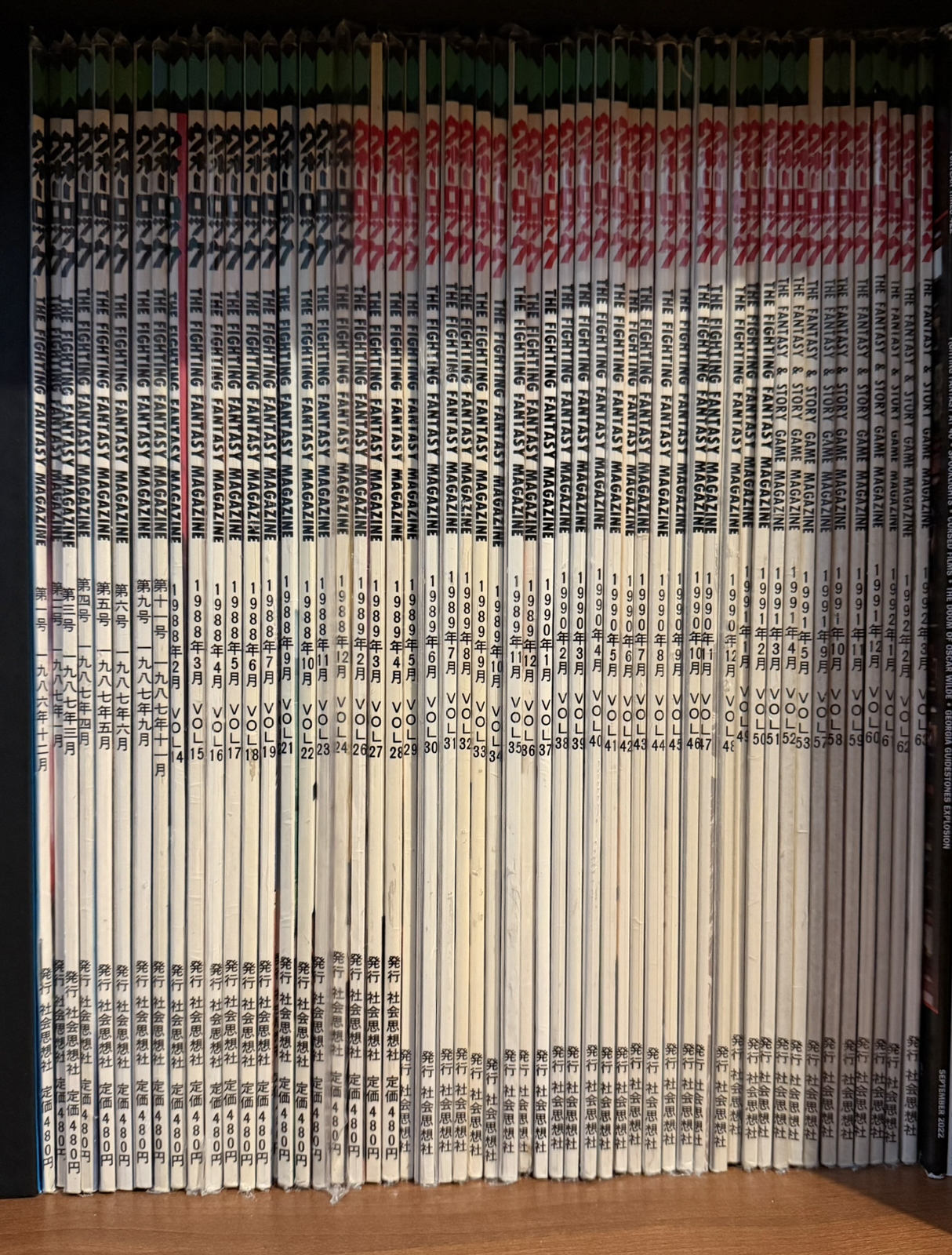
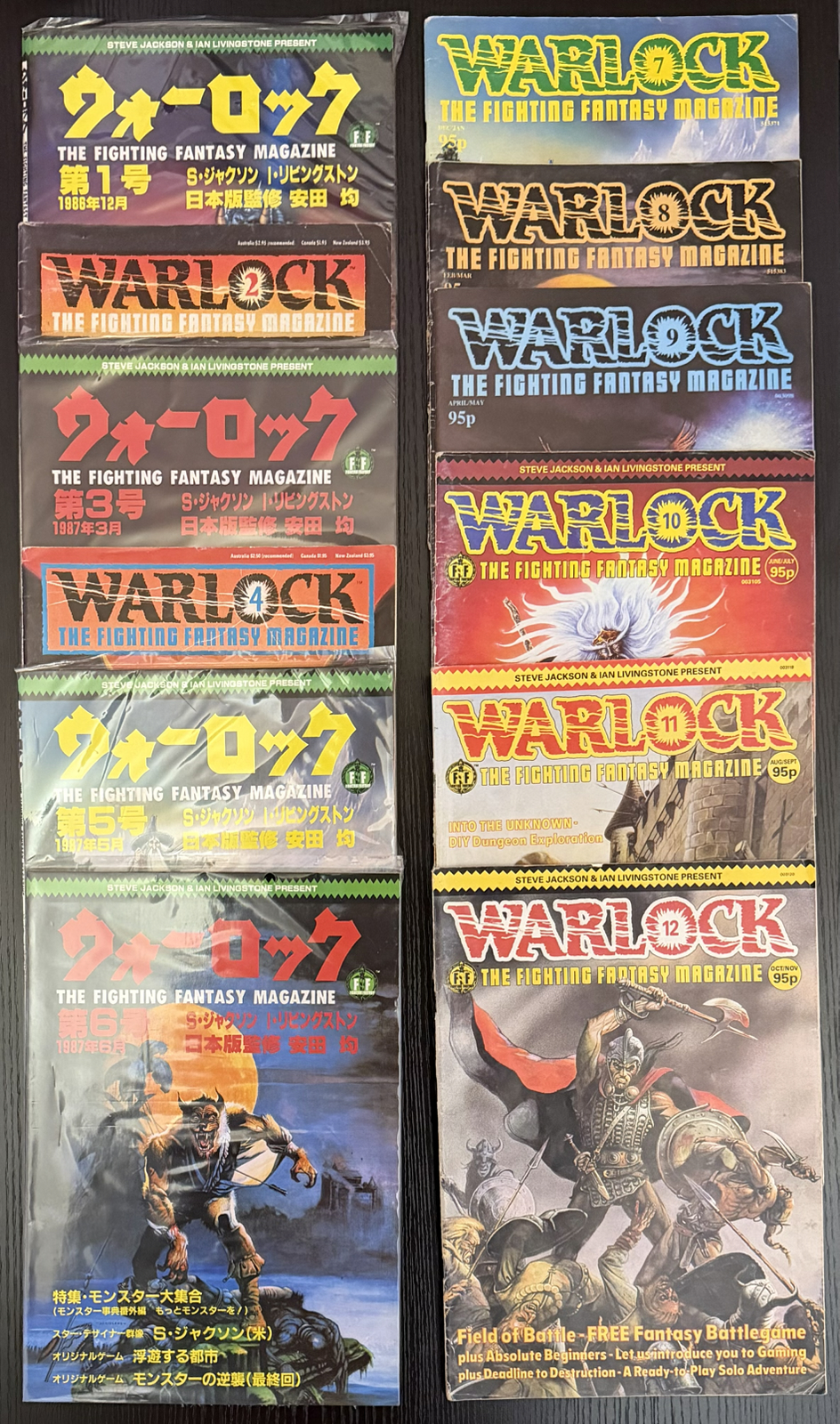
Speaking of which, I bought ten more issues of Warlock, which I found once again at Mandarake in Akihabara (where do they keep getting these from?). These weren’t cheap, but with this addition I now have 75% of the entire run of this magazine, including the first and last (#63) issues.

Moving onto one of my other collections, I found the above three Wizardry games. The leftmost had eluded me for years and was surprisingly inexpensive (about $30) but I didn’t even know Summoner had a PS2 version and didn’t hesitate to pay through the nose for it (~$100) when I found it in Nagano on Christmas Day. The last is the JP physical edition of the recent Wizardry 1 remake. Alas I was unable to find the special edition of this release, which comes with a lot of bonuses. One day I will…

This is a remarkable guidebook for all three Game Boy Color remakes of Wizardry 1 – 3. I’ve got many Japanese Wizardry game guides in my collection now, but this may be the best I’ve yet seen.

It starts with some lovely colour pages detailing the history of each game…

And then goes into detail about the specifics of the GBC versions of each title, including monsters, items and maps. Most of the book is in colour as well.

Each game gets its own section and as a result the book is fairly lengthy. The GBC versions of these games are rare and (very) expensive these days, so this book would have a limited audience. But I have all three games and will one day play them again and when I do this ‘bible’ will be extremely useful!

The above is the 1991 revised edition of the Wizardry TRPG rules for the tabletop game based on the video game series. I have read that the Wizardry TRPG was immensely popular back in Japan back in the day – competing even with D&D – but this is the first time I’d found a basic rule book for sale.

It’s got all the usual sections common to RPG rulebooks, and I like that the character sheet resembles those in the video games. I wonder what this game is like to play?

Speaking of the TRPG, I also bought the above. The two on the left are adventures, and on the right is a gamesmasters screen! These date to a few years before the rulebook above, which suggest they were intended for the first edition rules (which I’ve never seen). These were expensive, and only a maniac would buy them if he couldn’t even read them…

The above was an incredible find, not only because I’d never heard of it but also because I have since read it is ‘extremely rare’! It’s a Wizardry card game named after the ultimate wizard spell ‘Tiltowait’!

The description said it was ‘opened but never played’ and while the flimsy cardboard box had seen better days the cards themselves don’t show any evidence of use so I’m guessing the description was accurate.

Amusingly this is a reskin of Uno using monsters and spells from Wizardry as card art. From the included rules it seems ‘Tiltowait’ is the Draw 4 equivalent and other spells (‘Haman’ etc.) correspond to the other effect cards in Uno, with a few additions such as counter and discard spells.

The last game pickups from the trip were the above Switch titles. All of these are compilations of arcade games – mostly shooters. Taito Milestones 3 was purchased not just because it includes Cadash but also all three Rastan games and both Bubble Bobble and Rainbow Islands. It’s one of the very best arcade compilations I’ve seen! The game on the right is the special edition of Mushihimesama, the insect-themed Cave shooter.

Lots of treasures here, but alas my grails once again eluded me. The hunt will continue in future trips…