We got a new TV yesterday.
Sony Bravia KDL-V40XBR1
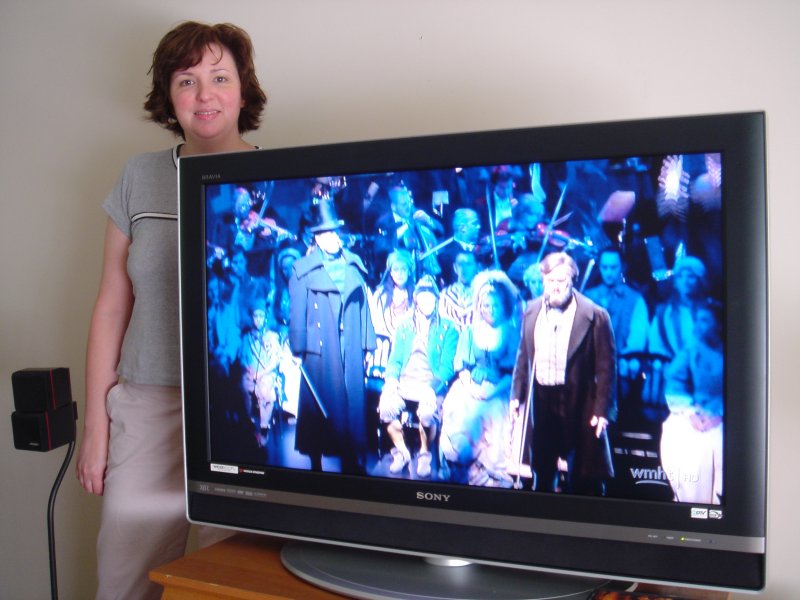
It’s a 40 inch LCD model, and here’s a shot:
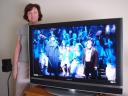 < KLS with her new toy
The TV replaces our old 32 inch XBR picture tube model. The upgrade is significant. Our old TV was merely ‘HD ready’ in that it could display a maximum resolution of 720p (that would be 1080×720 pixels) in a 4:3 aspect ratio.
As you can see the new model has a native 16:9 aspect ratio, but it also has a maximum resolution of 1366×768 and – much more importantly – a HMDI input (up to 1080i) which is essential for HD media signals. It is an LCD model, and the picture is alarmingly sharp and vibrant (to those of us used to picture tubes).
The TV has three component input jacks, one S-Video, 2 composite, one RGB, one USB and one HMDI slot. Right now I am using component inputs for the PS2 (which outputs at 480i), the Gamecube (480p), and the DVD player (480p). The S-Video is used by our TiVo, and the composite by the X-Box (both are, of course, sending an NTSC signal due to the limitations of their connections). It quickly became apparent that we needed better signals to get the most out of this new TV!
There is nothing we can do about the PS2 and Gamecube – both are displaying at the best possible resolutions for the systems. (The PS2 can ‘fake’ a widescreen signal, but it is still in 480i resolution maximum and simply squashes the image with a very fake result). Both my PS2’s (yes, I own 2) are older than fifth generation, which is where progressive scan output was added. So 480i is the best I can do with that (which, incidentally, looks great). The gamecube looks amazing at 480p anyway (By the way, the little letters ‘i’ and ‘p’ mean interlaced and progressive scanned (double the scan lines) respectively. The numbers mean the vertical pixel count. So 720p would be 1080×720 progressive scan).
The DVD player is an obvious weakpoint. Our player is probably five years old, outputs at a maximum 480p resolution and cannot upconvert to 720 or even 1080 signals. Newer models, including some for under US$100, can do exactly that.
However upconverting requires the use of the HDMI slot, since progressive scan cables have a limit of 720 resolution. And tomorrow I am going to Time Warner to pick up our brand new HMDI, HD-DVR. Yes that’s right – a true HD digital cable tuner with an HDMI output. These are brand new apparently, and will actually transmit a pixel-pixel 1920×1080 signal to the TV (not to mention record programs in this resolution). I can’t wait to see how it looks!
Anyway, since the DVR will be using the HDMI slot, that means I must find a DVD player that can upconvert to 720p via a component cable. I know for a fact Samsung makes one, and I’m sure others do. Since the prices are amazingly low these days for such things (I doubt we’d need to spend over maybe US$130) we may pick one up today at the store where we bought the TV (Tweeter).
Of course down the road we’ll probably have an X-Box 360, which can output at a maximum 720p resolution through component cables. A Playstation3 (maximum 1080i resolution which requires HDMI) and a Nintendo Wii (720p component). I’ll work out just where I’m going to be plugging these things in at a future date.
About the picture above. Astute readers may note that the TV is displaying a 16:9, very high quality image. Look in the lower right corner and you will read WMHT-HD. That is our local public access TV channel, but transmitted in HD. It turns out our local cable company transmits a few HD channels unscrambled, which means non-digital subscribers can pick them up. Of course tomorrow we’ll have access to all the non premium (monthly fee) HD channels, and I can’t wait to see how they look!