Category: Toys

The Most Legendary Of Items

Over the years both VFD games and Game & Watches have featured several times on this blog. I have a nostalgic fascination for both types of handheld game since both were an important element of my early gaming years.

Since I have often joked about BS seeking out and buying me a VFD game, and have many times bored KLS with stories of long-lost Game & Watches, you can imagine my surprise – no, astonishment – when on a recent trip to Rochester, a long-forgotten box of stuff from KLS’s childhood was unearthed and yielded one of each. And now I proudly present the latest two additions to my collection of Legendary Items:

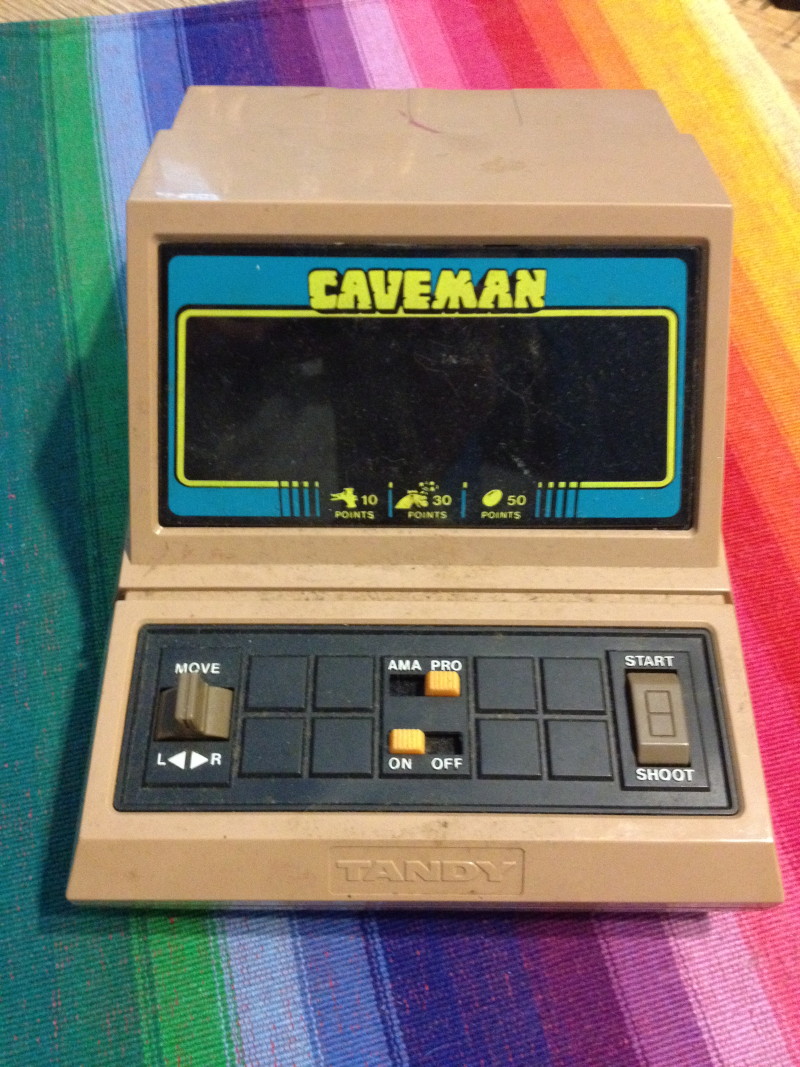
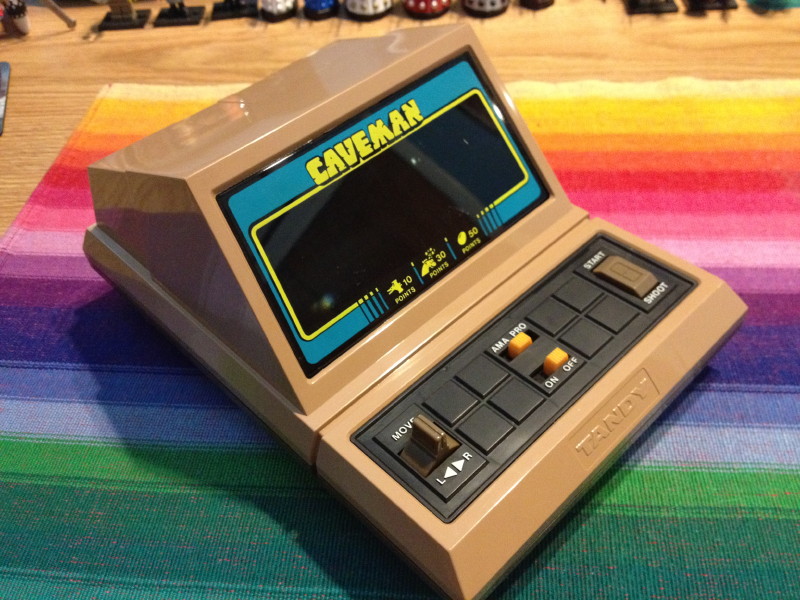
Caveman

IMG_1143a

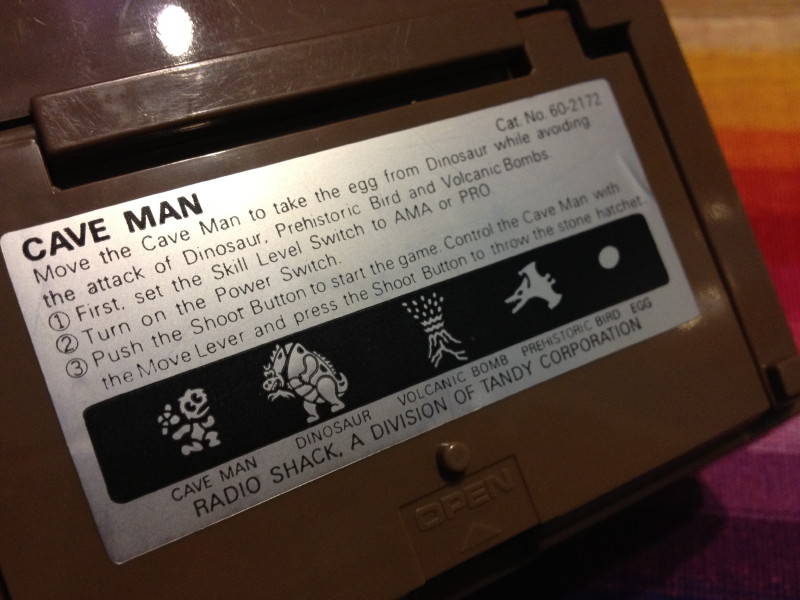
As found, the game was dirty (even a bit sticky) and hadn’t been used in aeons. This is the 1983 Tandy version of a game manufactured by Tomy Japan in 1982, and was amongst the first wave of VFD games ever made (this predated Scramble). Over the years I’ve read quite a bit about these things (I even have a book on handhelds…) and knowing that the VFD displays are unreliable I had great concern that this guy wouldn’t work. So I started by cleaning it:

IMG_1146a IMG_1145a

Then plugging in a 6V AC power supply. No luck – nothing happened. Unlike seemingly everything manufactured these days, these games use ‘C’ batteries, and we had none in the house. So a trip to the store later, I trepidatously put the batteries in and…

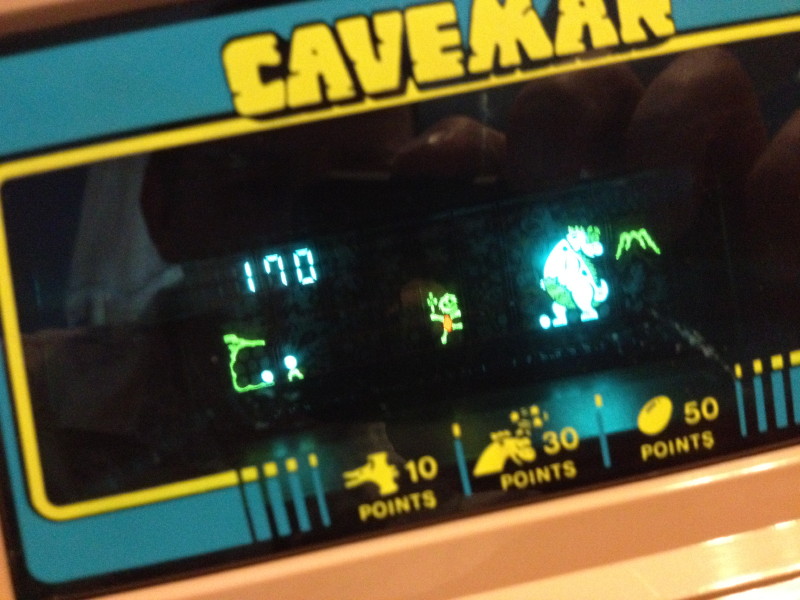
It worked!

IMG_1147a

The display, sound, controls. Everything works perfectly. I was elated!

This game seems to be quite rare today, possibly for reasons stated above. A brief search online found virtually none for sale, with the exception of one boxed example on ebay for $150. I’m going to treasure mine 🙂

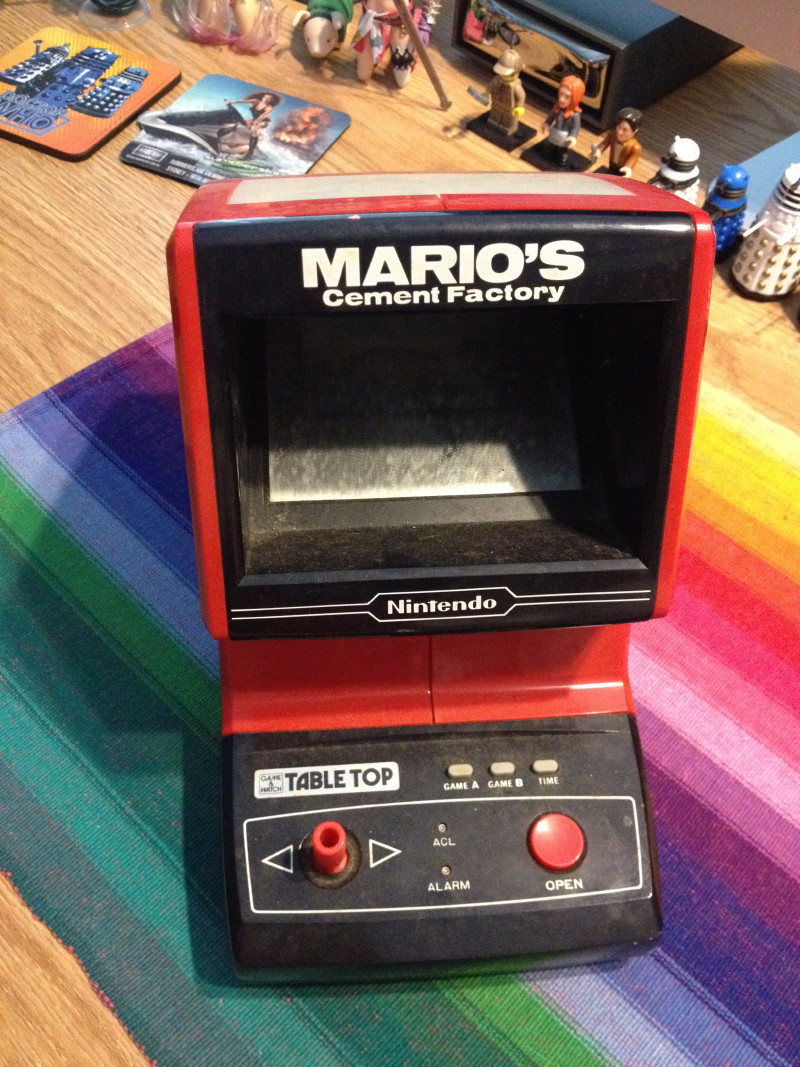
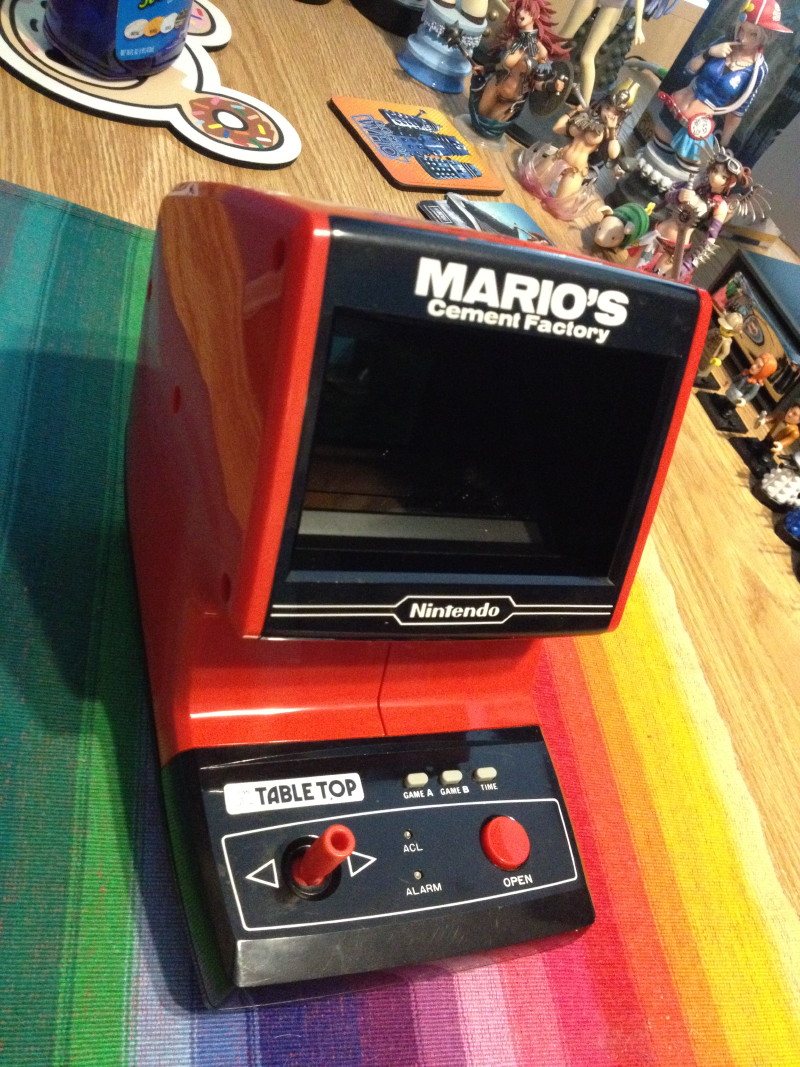
Mario’s Cement Factory

IMG_1140a

Of the two, this one gave me the biggest start when I saw it. Nintendo manufactured 59 different Game & Watch games between 1980 and 1990 and four of them were also made in a special colour ‘tabletop’ model. Only two of those four were ever sold outside of Japan, and Mario’s Cement Factory was the rarest of the two. It’s always been floating around somewhere in my brain as an ‘item I’d love to have’ because many, many years ago I saw a few of these being sold at clearance at a K-Mart in Australia and I never bought one (shades of the story behind this, wouldn’t you say?).

At any rate I now had my own Mario’s Cement Factory! But it was very dirty, especially the screen and the LCD panel. But I had high hopes for this guy, since the solid-state technology in Game & Watches is very robust (they can survive going through washing machines, for instance) and the mirror and panels in this example were intact. So once again, I sat down and gave it a careful and thorough cleaning!

IMG_1151a

The technology is simple but clever. You play by looking at the reflection in a mirror of an LCD mounted (in reverse) just under the white transparent plastic panel on the top. Light passes through this panel (and through the LCD) and is reflected off the mirror. Images are formed via the LCD blocking light and a plastic coloured film which makes the LCD itself appear coloured. Back in 1983 when this game out the technology seemed magical, since every other Game & Watch was black and white. Even today it is a very impressive bit of trickery created by Nintendo many years before actual colour LCDs became a reality.

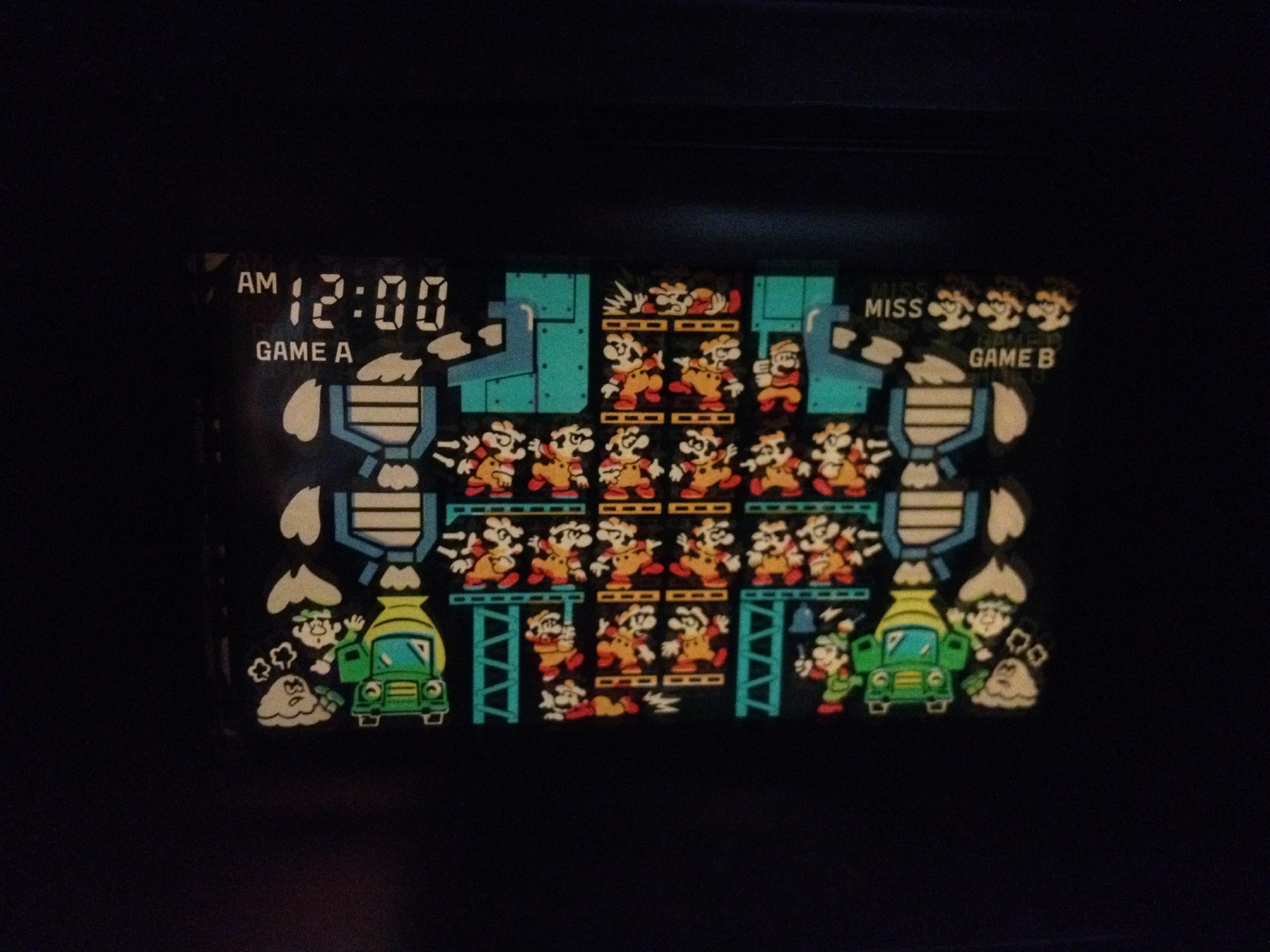
Oh, and it works! Here’s a shot of the full LCD panel after I put the batteries in:

IMG_1153a

Click on it and have a look at it in high resolution. You can see the ‘bleeding’ of the colour at the edges of the film, which would be due mostly to optical (refractive) events. They are tiny enough to not be visible when solid lines separate the elements (such as the concrete tanks) but easily visible on the Mario ‘sprites’. I wonder if the 11-year-old me would have noticed this if I got this back in 1983?

Here’s a video of the gameplay:

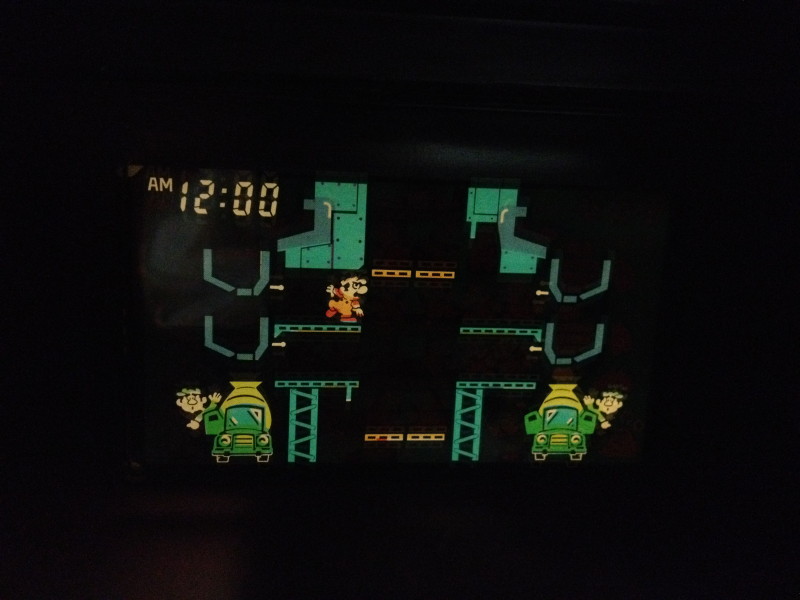
And a photo:

IMG_1154a

This is a real treasure! It cleaned up beautifully, is in near-mint condition, and works perfectly. It will occupy a place of great pride in my collection! Since I knew these were pretty rare (one source I checked estimated only about 30k were made for export) I checked the prices online. I couldn’t find any boxed examples, but there are a few on ebay that seem to be in worse shape than mine going for $130+. The Game & Watch name really helps, but it’s amazing how these things have gained value isn’t it?

I feel as if I have out-legendaried any other possible additions to my collection in obtaining these two. Could this be the last ever ‘legendary item’ post? Time will tell 🙂

Legendary Item 2

The other day I obtained my 259th Nintendo DS game. And it was no normal game, good readers, it was in fact… this:

gamewatch_collection2_big_1

Yes fellows, I now own the second in the Club Nintendo exclusive Game & Watch Collection series (I barely need mention I already own the first in the series)!

What is this game – which I remind you is unavailable in stores – you ask? It is none other than Parachute and Octopus coded for the DS. Here is an image showing both games in action:

gawc2

Remarkable, wouldn’t you say? But it doesn’t stop there! No, my friends, this humble DS cartridge also contains the brand new remix game Parachute x Octopus which is an unholy combination of both (let’s ignore for the moment reviews that say it’s terrible).

So where did I obtain this? Club Nintendo of course! It cost 800 ‘coins’, which are obtained by registering games and hardware. 800 coins equals about 16 Wii games, about 27 DS games, or about 5 hardware systems (DS, Wii, 3DS etc.). I’m proud to say I now own all three actual packaged games Nintendo has made available through the system (for which I spent a total of 2800 coins!)

Time for an honest disclosure: I haven’t yet played this. In fact I haven’t removed the shrinkwrap. But I love it nonetheless 🙂

Copter Feel

Over the last year, I have received not one, not two – but three toy helicopters as gifts! I’m a veritable helicopter magnet! Here then, a review of each of them.

I decided to test each of the helicopters on a course of my own devising, otherwise known as ‘I Am Maru book and cat ring toy’. Here’s a shot of the course:

IMG_0356

The intention was to take off from I Am Maru, fly gracefully through the air, and land inside the ring toy. Helicopters would be rated therefore not only on fun, but also on control. This is important when you’re dealing with a helicopter!

Helicopter 1: Execuheli

IMG_0350

The first copter I tested, a gift I’ve had for over a year, was the Execuheli. This helicopter is about 8 inches in length, has 2 rotors but no rear blade, and features LED lights both in the front and rear. The charger requires 6 AA batteries but the heli charges very quickly. It was manufactured in China.

IMG_0357

The above shot shows the (wireless) controller. The stick on the left controls the rotor speed, and the stick on the right controls the orientation of the copter. Which means, in principle, you can control the flight of the bird by changing direction with the stick on the right. In reality… not so easy! But first, an action shot:

IMG_0361

Yes my friends, there we have Execuheli in flight! You can see I had modified the course a bit, specifically by adding a tower of Star Wars tins, but this was a moot change since this helicopter was beyond my control! Oh I could get it flying easily enough, but where it went from there was entirely up to it! The right stick felt more like a binary toggle switch between ‘on the bleeding edge of control’ and ‘utterly out of control’ and tiny twiddles of it led instantly to spectacular crashes.

Verdict: Execuheli leaves the ground, but rarely made it back alive 🙂

Helicopter 2: Stinger

The next copter, a gift from my brother, was a marvel of miniaturization called Stinger.

IMG_0353

This baby is tiny – only about 5 inches in length, and features 2 rotors, a rear rotor, flashing LED’s and gyroscopic control (although, to be honest, I’m sure they all feature that). It is spectacularly lightweight – it feels like nothing in your hand. And it’s very, very pretty. This little marvel was made in the PRC.

IMG_0371

Stinger flies with slightly more control than Execuheli (perhaps due to the rear rotor?), and responds better to slight adjustements of the controller. Unlike the previous copter, I was actually able to keep this guy aloft for relatively long periods. Here’s a video of the action:

You can see the flight is smooth, stable and almost under my control. At least until it attacked me in the bollocks.

Verdict: A clever and fun little toy!

Helicopter 3: i-helicopter air

To the last of the three, one of my Christmas gifts, is the pompously named i-helicopter air.

IMG_0351

You’ve probably seen these advertised: helicopters that are controlled by your i-device (iPhone, iPad, iPod). The copter itself is by far the largest of the three I own (probably over 10 inches in length), which means it is also the heaviest. Strangely it also has the least amount of tech – missing a rear rotor and only having one (non flashing) LED. It charges from a USB cable, and took by far the longest to charge as well. This helicopter was made in ??.

IMG_0382

The above shot shows the i-helicopter air and the controller, which is to say KLS’s iPad. The helicopter itself came with the IR transmitter you can see plugged into the iPad, and the control software had to be downloaded (free) from the App Store. I’ll admit I was nervous, since the reviews are bad and many comments say the helicopter simply doesn’t work, or when it does the lag is so great that it’s uncontrollable. It was with some hesitation that I fired it up the first time.

IMG_0384

But I was to be pleasantly surprised! Not only did it work, but the helicopter flew gracefully and with great stability. Granted the control was almost nonexistant (it doesn’t turn, for instance), but it was stable enough (unlike Execuheli) that it could just hover without moving quite well and look good doing it. Yes there is a control delay, and yes the lack of turning is an issue, but the stability of this helicopter was perhaps the greatest and it was the only one I successfully landed.

Verdict: Gimmicky control, but well built craft.

Overall, there is a clear winner here between the three, and that is unquestionably Stinger. It was the most fun, had the most flashing lights, and had the best control. It was also the smallest, which made the technology seem even cooler. These things are sold under zillions of names in gazillions of configurations, but I’ll conclude based on this test that at the very least you should look for tail rotors and lots of flashing LED’s if you’re in the market for a toy helicopter.

That said, I must be honest and admit that all of these toys contain a high level of frustration since ‘controlling’ them seems a crapshoot at best. This is true of all helicopters though, and faulting them for this is like faulting a fish for swimming. Helicopter toys are by their nature very difficult to control, and it’s a marvel that any of these (especially the tiny Stinger) do the job as well as they do.